
📿 Practice Guides
Bhaja Govindam: Sanskrit Lyrics, Transliteration and Meaning
Bhaja Govindam, also called Moha Mudgara, is a 31-verse Sanskrit poem traditionally attributed to Adi Shankaracharya. Here is the widely recited Sanskrit, a clear transliteration and an original English meaning of each verse.
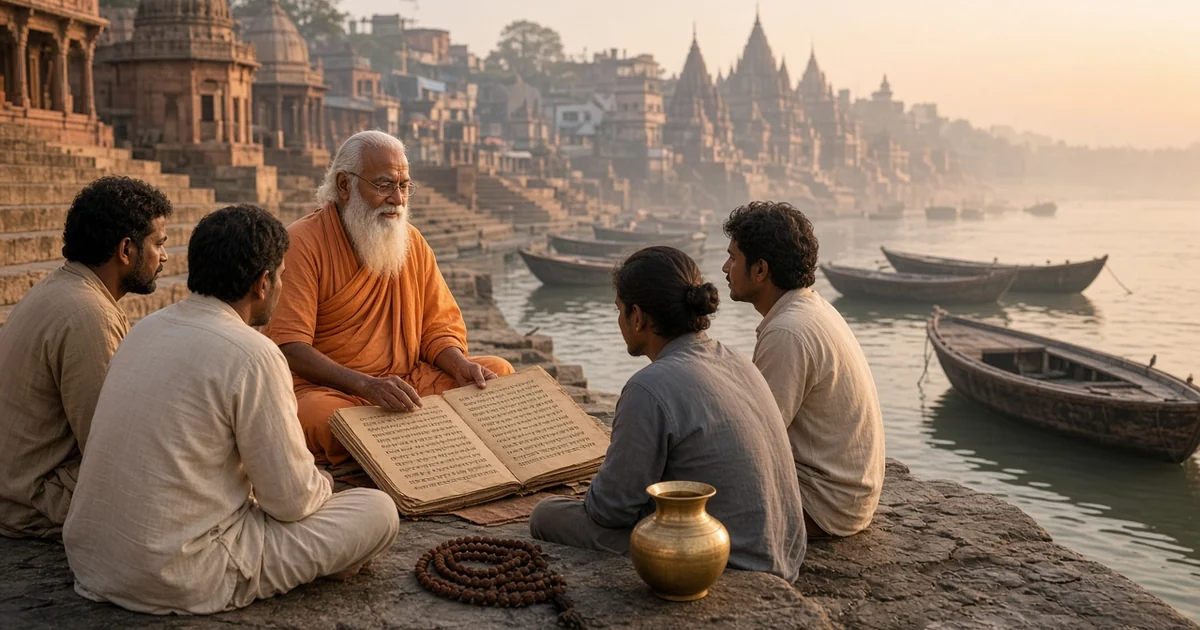
Bhaja Govindam, also called Moha Mudgara (“the hammer on delusion”), is a 31-verse Sanskrit poem traditionally attributed to Adi Shankaracharya. Its opening line is an urgent refrain: bhaja govindaṃ bhaja govindaṃ govindaṃ bhaja mūḍhamate — “Worship Govinda, worship Govinda, O foolish mind.” The poem then walks through the passing of youth, wealth, family and the body, and points the reader toward good company, a little daily practice, and the question “Who am I?”
The traditional story is set in Kashi. Shankara, the story says, saw an old scholar still absorbed in Panini’s grammatical formula ḍukṛñ karaṇe and told him that those rules would not help when death drew near, whereas seeking Govinda would. He then, according to the same tradition, unfolded the next verses; fourteen more were offered by his disciples, and he added the closing stanzas. The story is how the poem has long been introduced. It is a tradition, not a modern historical proof, and the exact authorship of each middle verse cannot be shown.
This page gives the widely recited 31-verse Sanskrit, a letter-by-letter transliteration, and an original English meaning of each verse, written from the Sanskrit rather than copied from another translation.
How the poem is traditionally recited
The first verse can be used as a refrain after every stanza, or the 31 verses can be sung straight through. Choose a quiet time — early morning, the end of study, or a day such as Ekadashi or Gita Jayanti. Sit upright, read each verse slowly enough to notice the image, and only then add a tune if you wish. The poem is short enough to learn a few stanzas a week.
A few verses are blunt. They belong to a genre that loosens attachment by exaggeration, and they should not be taken as a complete account of family life. Verse 3, which speaks of a woman’s body, is addressed to a male renunciant audience; modern readers often skip or soften it, and the poem does not need it in order to make its point. Recitation is a spiritual practice, not a substitute for medical, legal or practical help.
Govinda is a name of Krishna. For a companion practice, see the Krishna mantra, the Vishnu Sahasranama, or a simple daily Gita reading plan. A wider set of hymns is gathered in powerful Vishnu mantras and in the beginner’s guide to Hindu mantras.
The 31 verses
Verse 1
भज गोविन्दं भज गोविन्दं गोविन्दं भज मूढमते । सम्प्राप्ते सन्निहिते काले नहि नहि रक्षति डुकृङ्करणे ॥१॥
Transliteration: bhaja govindaṃ bhaja govindaṃ govindaṃ bhaja mūḍhamate | samprāpte sannihite kāle nahi nahi rakṣati ḍukṛṅkaraṇe ||1||
Meaning: Worship Govinda, worship Govinda, worship Govinda, O foolish mind. When the appointed time has drawn near, the rules of grammar — ḍukṛñ karaṇe — will not save you.
Verse 2
मूढ जहीहि धनागमतृष्णां कुरु सद्बुद्धिं मनसि वितृष्णाम् । यल्लभसे निजकर्मोपात्तं वित्तं तेन विनोदय चित्तम् ॥२॥
Transliteration: mūḍha jahīhi dhanāgamatṛṣṇāṃ kuru sadbuddhiṃ manasi vitṛṣṇām | yallabhase nijakarmopāttaṃ vittaṃ tena vinodaya cittam ||2||
Meaning: O fool, give up the thirst for amassing wealth and set a good, desireless mind within. Be content with the wealth that comes as the fruit of your own past action, and with that, gladden the heart.
Verse 3
नारीस्तनभरनाभीदेशं दृष्ट्वा मा गा मोहावेशम् । एतन्मांसवसादिविकारं मनसि विचिन्तय वारं वारम् ॥३॥
Transliteration: nārīstanabharanābhīdeśaṃ dṛṣṭvā mā gā mohāveśam | etanmāṃsavasādivikāraṃ manasi vicintaya vāraṃ vāram ||3||
Meaning: Do not fall into the grip of delusion at the sight of a woman’s breast and navel. Reflect in the mind, again and again, that this is a modification of flesh and fat. (The verse is addressed to a male renunciant audience and uses a harsh image to loosen attachment; it is not a statement about the worth of women. Some readers skip or soften it; the poem’s argument does not depend on it alone.)
Verse 4
नलिनीदलगतजलमतितरलं तद्वज्जीवितमतिशयचपलम् । विद्धि व्याध्यभिमानग्रस्तं लोकं शोकहतं च समस्तम् ॥४॥
Transliteration: nalinīdalagatajalamatitaralaṃ tadvajjīvitamatiśayacapalam | viddhi vyādhyabhimānagrastaṃ lokaṃ śokahataṃ ca samastam ||4||
Meaning: Life is as unsteady as water on a lotus leaf. Know that the whole world is seized by disease and by pride, and is struck by grief.
Verse 5
यावद्वित्तोपार्जनसक्तस्तावन्निजपरिवारो रक्तः । पश्चाज्जीवति जर्जरदेहे वार्तां कोऽपि न पृच्छति गेहे ॥५॥
Transliteration: yāvadvittopārjanasaktastāvannijaparivāro raktaḥ | paścājjīvati jarjaradehe vārtāṃ ko’pi na pṛcchati gehe ||5||
Meaning: So long as a person is busy earning wealth, the family is warmly attached. Later, when that person lives on in a worn-out body, no one in the house even asks for news.
Verse 6
यावत्पवनो निवसति देहे तावत्पृच्छति कुशलं गेहे । गतवति वायौ देहापाये भार्या बिभ्यति तस्मिन्काये ॥६॥
Transliteration: yāvatpavano nivasati dehe tāvatpṛcchati kuśalaṃ gehe | gatavati vāyau dehāpāye bhāryā bibhyati tasminkāye ||6||
Meaning: So long as the breath dwells in the body, the household asks after one’s welfare. When the breath has gone and the body is spent, even a wife fears that same body.
Verse 7
बालस्तावत्क्रीडासक्तः तरुणस्तावत्तरुणीसक्तः । वृद्धस्तावच्चिन्तासक्तः परमे ब्रह्मणि कोऽपि न सक्तः ॥७॥
Transliteration: bālastāvatkrīḍāsaktaḥ taruṇastāvattaruṇīsaktaḥ | vṛddhastāvaccintāsaktaḥ parame brahmaṇi ko’pi na saktaḥ ||7||
Meaning: In childhood one is attached to play; in youth, to a young woman; in old age, to worry. Hardly anyone is attached to the supreme Brahman. (A common variant of the last quarter reads pare brahmani, “the highest Brahman,” for parame brahmani.)
Verse 8
का ते कान्ता कस्ते पुत्रः संसारोऽयमतीव विचित्रः । कस्य त्वं कः कुत आयातस्तत्त्वं चिन्तय तदिह भ्रातः ॥८॥
Transliteration: kā te kāntā kaste putraḥ saṃsāro’yamatīva vicitraḥ | kasya tvaṃ kaḥ kuta āyātastattvaṃ cintaya tadiha bhrātaḥ ||8||
Meaning: Who is your wife? Who is your son? This wandering world is utterly strange. Whose are you? Who are you? From where have you come? Reflect on that truth here, O brother.
Verse 9
सत्सङ्गत्वे निस्सङ्गत्वं निस्सङ्गत्वे निर्मोहत्वम् । निर्मोहत्वे निश्चलतत्त्वं निश्चलतत्त्वे जीवन्मुक्तिः ॥९॥
Transliteration: satsaṅgatve nissaṅgatvaṃ nissaṅgatve nirmohatvam | nirmohatve niścalatattvaṃ niścalatattve jīvanmuktiḥ ||9||
Meaning: From good company comes non-attachment; from non-attachment, freedom from delusion; from freedom from delusion, a steady truth; from that steady truth, liberation while still living. (Some printed editions read niscalitatvam, “a settled, unmoving state,” rather than niscalatattvam, “the unmoving truth.”)
Verse 10
वयसि गते कः कामविकारः शुष्के नीरे कः कासारः । क्षीणे वित्ते कः परिवारः ज्ञाते तत्त्वे कः संसारः ॥१०॥
Transliteration: vayasi gate kaḥ kāmavikāraḥ śuṣke nīre kaḥ kāsāraḥ | kṣīṇe vitte kaḥ parivāraḥ jñāte tattve kaḥ saṃsāraḥ ||10||
Meaning: When youth is gone, what becomes of passion? When the water has dried, what is a lake? When wealth is gone, what is a family? When the truth is known, what is this wandering world?
Verse 11
मा कुरु धनजनयौवनगर्वं हरति निमेषात्कालः सर्वम् । मायामयमिदमखिलं हित्वा बुध्वा ब्रह्मपदं त्वं प्रविश विदित्वा ॥११॥
Transliteration: mā kuru dhanajanayauvanagarvaṃ harati nimeṣātkālaḥ sarvam | māyāmayamidamakhilaṃ hitvā budhvā brahmapadaṃ tvaṃ praviśa viditvā ||11||
Meaning: Do not take pride in wealth, in people or in youth: time takes everything in the blink of an eye. Give up this entire world of appearance, know it, and enter the state of Brahman.
Verse 12
दिनयामिन्यौ सायं प्रातः शिशिरवसन्तौ पुनरायातः । कालः क्रीडति गच्छत्यायुस्तदपि न मुञ्चत्याशावायुः ॥१२॥
Transliteration: dinayāminyau sāyaṃ prātaḥ śiśiravasantau punarāyātaḥ | kālaḥ krīḍati gacchatyāyustadapi na muñcatyāśāvāyuḥ ||12||
Meaning: Day and night, evening and morning, winter and spring come again. Time plays, and life goes on — and still one does not give up the gust of desire.
Verse 13
का ते कान्ता धनगतचिन्ता वातुल किं तव नास्ति नियन्ता । त्रिजगति सज्जनसङ्गतिरेका भवति भवार्णवतरणे नौका ॥१३॥
Transliteration: kā te kāntā dhanagatacintā vātula kiṃ tava nāsti niyantā | trijagati sajjanasaṅgatirekā bhavati bhavārṇavataraṇe naukā ||13||
Meaning: Why this anxiety about a wife and about wealth, O distracted one? Have you no one who guides you? In all the three worlds, the company of good people is the one boat that carries a person across the ocean of becoming.
Verse 14
जटिलो मुण्डी लुञ्छितकेशः काषायाम्बरबहुकृतवेषः । पश्यन्नपि च न पश्यति मूढो ह्युदरनिमित्तं बहुकृतवेषः ॥१४॥
Transliteration: jaṭilo muṇḍī luñchitakeśaḥ kāṣāyāmbarabahukṛtaveṣaḥ | paśyannapi ca na paśyati mūḍho hyudaranimittaṃ bahukṛtaveṣaḥ ||14||
Meaning: Matted hair, a shaven head, plucked hair, and many costumes of ochre cloth: the fool, even while looking, does not see. All these many costumes are only for the sake of the stomach.
Verse 15
अङ्गं गलितं पलितं मुण्डं दशनविहीनं जातं तुण्डम् । वृद्धो याति गृहीत्वा दण्डं तदपि न मुञ्चत्याशापिण्डम् ॥१५॥
Transliteration: aṅgaṃ galitaṃ palitaṃ muṇḍaṃ daśanavihīnaṃ jātaṃ tuṇḍam | vṛddho yāti gṛhītvā daṇḍaṃ tadapi na muñcatyāśāpiṇḍam ||15||
Meaning: The body is worn, the head is grey, the mouth is empty of teeth. The old person walks with a staff — and still does not give up the lump of hope.
Verse 16
अग्रे वह्निः पृष्ठे भानुः रात्रौ चुबुकसमर्पितजानुः । करतलभिक्षस्तरुतलवासस्तदपि न मुञ्चत्याशापाशः ॥१६॥
Transliteration: agre vahniḥ pṛṣṭhe bhānuḥ rātrau cubukasamarpitajānuḥ | karatalabhikṣastarutalavāsastadapi na muñcatyāśāpāśaḥ ||16||
Meaning: Fire in front, the sun at the back, at night the chin resting on the knees; alms in the palm and a dwelling at the foot of a tree — and still one does not let go the noose of desire.
Verse 17
कुरुते गङ्गासागरगमनं व्रतपरिपालनमथवा दानम् । ज्ञानविहीनः सर्वमतेन मुक्तिं न भजति जन्मशतेन ॥१७॥
Transliteration: kurute gaṅgāsāgaragamanaṃ vrataparipālanamathavā dānam | jñānavihīnaḥ sarvamatena muktiṃ na bhajati janmaśatena ||17||
Meaning: A person may go to Ganga-sagara, keep vows and give gifts. Yet, says every school, one without knowledge does not attain liberation even in a hundred births.
Verse 18
सुरमंदिरतरुमूलनिवासः शय्या भूतलमजिनं वासः । सर्वपरिग्रहभोगत्यागः कस्य सुखं न करोति विरागः ॥१८॥
Transliteration: suramaṃdiratarumūlanivāsaḥ śayyā bhūtalamajinaṃ vāsaḥ | sarvaparigrahabhogatyāgaḥ kasya sukhaṃ na karoti virāgaḥ ||18||
Meaning: Dwelling at a temple or at the foot of a tree, a bed on the earth, a garment of deerskin, the giving up of every possession and enjoyment — for whom does such dispassion not bring happiness?
Verse 19
योगरतो वा भोगरतो वा सङ्गरतो वा सङ्गविहीनः । यस्य ब्रह्मणि रमते चित्तं नन्दति नन्दति नन्दत्येव ॥१९॥
Transliteration: yogarato vā bhogarato vā saṅgarato vā saṅgavihīnaḥ | yasya brahmaṇi ramate cittaṃ nandati nandati nandatyeva ||19||
Meaning: Whether one is given to yoga or to enjoyment, to company or to solitude — if the mind delights in Brahman, that person rejoices, rejoices, and only rejoices.
Verse 20
भगवद्गीता किञ्चिदधीता गङ्गाजललवकणिका पीता । सकृदपि येन मुरारिसमर्चा क्रियते तस्य यमेन न चर्चा ॥२०॥
Transliteration: bhagavadgītā kiñcidadhītā gaṅgājalalavakaṇikā pītā | sakṛdapi yena murārisamarcā kriyate tasya yamena na carcā ||20||
Meaning: A little of the Bhagavad Gita read, a drop of Ganga water drunk, worship of Murari offered even once: for that person, Yama has no case to argue.
Verse 21
पुनरपि जननं पुनरपि मरणं पुनरपि जननीजठरे शयनम् । इह संसारे बहुदुस्तारे कृपयाऽपारे पाहि मुरारे ॥२१॥
Transliteration: punarapi jananaṃ punarapi maraṇaṃ punarapi jananījaṭhare śayanam | iha saṃsāre bahudustāre kṛpayā’pāre pāhi murāre ||21||
Meaning: Again birth, again death, again lying in a mother’s womb. In this wandering world, so hard to cross, O Murari, in your boundless compassion, protect me.
Verse 22
रथ्याचर्पटविरचितकन्थः पुण्यापुण्यविवर्जितपन्थः । योगी योगनियोजितचित्तो रमते बालोन्मत्तवदेव ॥२२॥
Transliteration: rathyācarpaṭaviracitakanthaḥ puṇyāpuṇyavivarjitapanthaḥ | yogī yoganiyojitacitto ramate bālonmattavadeva ||22||
Meaning: A cloak stitched from rags picked up on the road; a path beyond merit and demerit. The yogi whose mind is yoked in yoga delights like a child, or like one who is mad.
Verse 23
कस्त्वं कोऽहं कुत आयातः का मे जननी को मे तातः । इति परिभावय सर्वमसारम् विश्वं त्यक्त्वा स्वप्नविचारम् ॥२३॥
Transliteration: kastvaṃ ko’haṃ kuta āyātaḥ kā me jananī ko me tātaḥ | iti paribhāvaya sarvamasāram viśvaṃ tyaktvā svapnavicāram ||23||
Meaning: Who are you? Who am I? From where have I come? Who is my mother, who is my father? Reflect in this way that everything is without substance, and give up the world as one gives up a dream.
Verse 24
त्वयि मयि चान्यत्रैको विष्णुर्व्यर्थं कुप्यसि मय्यसहिष्णुः । भव समचित्तः सर्वत्र त्वं वाञ्छस्यचिराद्यदि विष्णुत्वम् ॥२४॥
Transliteration: tvayi mayi cānyatraiko viṣṇurvyarthaṃ kupyasi mayyasahiṣṇuḥ | bhava samacittaḥ sarvatra tvaṃ vāñchasyacirādyadi viṣṇutvam ||24||
Meaning: In you, in me and elsewhere there is one Vishnu. Why do you become impatient and angry with me in vain? Be even-minded everywhere, if you wish, before long, to reach the state of Vishnu.
Verse 25
शत्रौ मित्रे पुत्रे बन्धौ मा कुरु यत्नं विग्रहसन्धौ । सर्वस्मिन्नपि पश्यात्मानं सर्वत्रोत्सृज भेदाज्ञानम् ॥२५॥
Transliteration: śatrau mitre putre bandhau mā kuru yatnaṃ vigrahasandhau | sarvasminnapi paśyātmānaṃ sarvatrotsṛja bhedājñānam ||25||
Meaning: Toward enemy and friend, son and kinsman, do not strive either to quarrel or to make alliance. See the Self in all, and everywhere give up the ignorance of difference.
Verse 26
कामं क्रोधं लोभं मोहं त्यक्त्वाऽऽत्मानं भावय कोऽहम् । आत्मज्ञानविहीना मूढास्ते पच्यन्ते नरकनिगूढाः ॥२६॥
Transliteration: kāmaṃ krodhaṃ lobhaṃ mohaṃ tyaktvā’’tmānaṃ bhāvaya ko’ham | ātmajñānavihīnā mūḍhāste pacyante narakanigūḍhāḥ ||26||
Meaning: Giving up desire, anger, greed and delusion, contemplate the Self: “Who am I?” Those fools who are without knowledge of the Self are cooked in the hidden depths of a hellish state. (A common variant of the first line reads pasyati so’ham, “he sees ‘I am that,’” in place of bhavaya ko’ham, “contemplate ‘Who am I?’”)
Verse 27
गेयं गीतानामसहस्रं ध्येयं श्रीपतिरूपमजस्रम् । नेयं सज्जनसङ्गे चित्तं देयं दीनजनाय च वित्तम् ॥२७॥
Transliteration: geyaṃ gītānāmasahasraṃ dhyeyaṃ śrīpatirūpamajasram | neyaṃ sajjanasaṅge cittaṃ deyaṃ dīnajanāya ca vittam ||27||
Meaning: The Gita and the thousand names are to be sung; the form of the Lord of Shri is to be meditated on without pause. The mind is to be led into the company of the good, and wealth is to be given to those in need.
Verse 28
सुखतः क्रियते रामाभोगः पश्चाद्धन्त शरीरे रोगः । यद्यपि लोके मरणं शरणं तदपि न मुञ्चति पापाचरणम् ॥२८॥
Transliteration: sukhataḥ kriyate rāmābhogaḥ paścāddhanta śarīre rogaḥ | yadyapi loke maraṇaṃ śaraṇaṃ tadapi na muñcati pāpācaraṇam ||28||
Meaning: Pleasure is enjoyed at ease — and afterwards, alas, there is disease in the body. Even though in this world death is the only shelter, still one does not give up sinful conduct.
Verse 29
अर्थमनर्थं भावय नित्यं नास्तिततः सुखलेशः सत्यम् । पुत्रादपि धनभाजां भीतिः सर्वत्रैषा विहिता रीतिः ॥२९॥
Transliteration: arthamanarthaṃ bhāvaya nityaṃ nāstitataḥ sukhaleśaḥ satyam | putrādapi dhanabhājāṃ bhītiḥ sarvatraiṣā vihitā rītiḥ ||29||
Meaning: Reflect every day that wealth is a source of harm: truly, there is not even a trace of happiness from it. Even from their own sons, those who have much wealth have fear. This is the way of things everywhere.
Verse 30
प्राणायामं प्रत्याहारं नित्यानित्य विवेकविचारम् । जाप्यसमेतसमाधिविधानं कुर्ववधानं महदवधानम् ॥३०॥
Transliteration: prāṇāyāmaṃ pratyāhāraṃ nityānitya vivekavicāram | jāpyasametasamādhividhānaṃ kurvavadhānaṃ mahadavadhānam ||30||
Meaning: The regulation of the breath, the withdrawal of the senses, reflection that distinguishes the lasting from the passing; the practice of recitation together with samadhi — do these with great care, with the utmost care.
Verse 31
गुरुचरणाम्बुजनिर्भरभक्तः संसारादचिराद्भव मुक्तः । सेन्द्रियमानसनियमादेवं द्रक्ष्यसि निजहृदयस्थं देवम् ॥३१॥
Transliteration: gurucaraṇāmbujanirbharabhaktaḥ saṃsārādacirādbhava muktaḥ | sendriyamānasaniyamādevaṃ drakṣyasi nijahṛdayasthaṃ devam ||31||
Meaning: The devotee who is wholly given to the lotus feet of the teacher is freed from the wandering world before long. By this discipline of the senses and the mind you will see the Lord who dwells in your own heart.
Text notes
The Sanskrit above follows the widely recited 31-verse recension traditionally attributed to Adi Shankaracharya, checked against the proofread Sanskrit Documents edition (transliterated and proofread by M. Giridhar, with later proofreading by N. A. and P. S. A. Easwaran). That edition itself notes that the last two of some 33-verse booklets are not found in every older printing; they are omitted here. Other points of variation:
- Verse 1: many singers use prāpte sannihite maraṇe (“when death has drawn near”) in place of samprāpte sannihite kāle (“when the appointed time has drawn near”).
- Verse 7: some editions read pare brahmaṇi for parame brahmaṇi.
- Verse 9: some printed editions read niścalitatvaṃ (“a settled state”) rather than niścalatattvaṃ (“the unmoving truth”).
- Verse 26: a common variant of the first line is paśyati so’ham in place of bhāvaya ko’ham.
- A shorter, separately printed recension called Charpata Panjarika has 17 stanzas in a different order, with the opening refrain after every verse.
If you are learning the poem by heart, stay with one printed edition or a teacher so the small differences do not unsettle the recitation.
The English meanings on this page are original to VedicVani. They aim to say plainly what the Sanskrit names, not to replace a word-for-word scholarly commentary.
Related reading
For Krishna and the Gita, see who wrote the Bhagavad Gita, the Gita Jayanti 2026 study guide, and Bhagavad Gita shlokas with meaning. For companion Shankara hymns, see the Dakshinamurthy Stotram, the Nirvana Shatakam, the Soundarya Lahari, and the Guru Stotram. For related practice, see the meaning of Om, how to start a daily mantra practice, and Vaikuntha Ekadashi 2026.
Frequently Asked Questions
Who wrote Bhaja Govindam?
The poem is traditionally attributed to Adi Shankaracharya. A well-known story says he composed the opening verse in Kashi on seeing an old scholar absorbed in the rules of Sanskrit grammar, then added further verses, with fourteen more offered by his disciples. The story is traditional rather than a modern historical proof, and the exact authorship of individual middle verses cannot be demonstrated.
How many verses are in Bhaja Govindam?
The widely printed recension has 31 verses. The first verse is the refrain; verses 2 to 13 are often called the Dvadasha Manjarika; a further fourteen are traditionally ascribed to disciples (the Chaturdasha Manjarika); and Shankara is said to have added closing verses. Some booklets print 33 or 34 stanzas by adding a colophon after verse 12 and two final lines. Those additions are not in every older printed edition and are not included here.
What does Bhaja Govindam mean?
Bhaja Govindam means 'worship Govinda' or 'seek Govinda.' Govinda is a name of Krishna, and in this poem it also stands for the divine reality the seeker is asked to turn to. The older title Moha Mudgara means 'the hammer (or mallet) on delusion.'
When should I recite Bhaja Govindam?
It can be recited on any day, and it is especially fitting on Ekadashi, on Gita Jayanti, or at the beginning or end of a period of study. The first verse is often used as a refrain after each stanza, or the whole poem is sung straight through. It is short enough to learn a few verses at a time.
What is the story behind Bhaja Govindam?
The traditional account is that, in Kashi, Shankara saw an aged scholar still drilling the grammatical formula dukrn karane and was moved to tell him that grammar would not help at the hour of death, whereas worship of Govinda would. He then, the story says, unfolded the rest of the poem. The verses themselves do not narrate this scene; it is how the tradition has long introduced the work.
Are there different versions of the text?
Yes. Besides the 31-verse recension used here, there is a shorter recension, often called Charpata Panjarika, with a different order and a refrain after every stanza. Individual words also vary: the first verse is sung both as samprapte sannihite kale and as prapte sannihite marane. Stay with one edition if you are learning the poem by heart.