
🪷 Hindu Philosophy
14 Lokas in Hinduism: Names, Order, and Meaning
A careful guide to the fourteen lokas of Hindu cosmology, from Bhuloka to Satyaloka and Atala to Patala, with context from Puranic traditions.
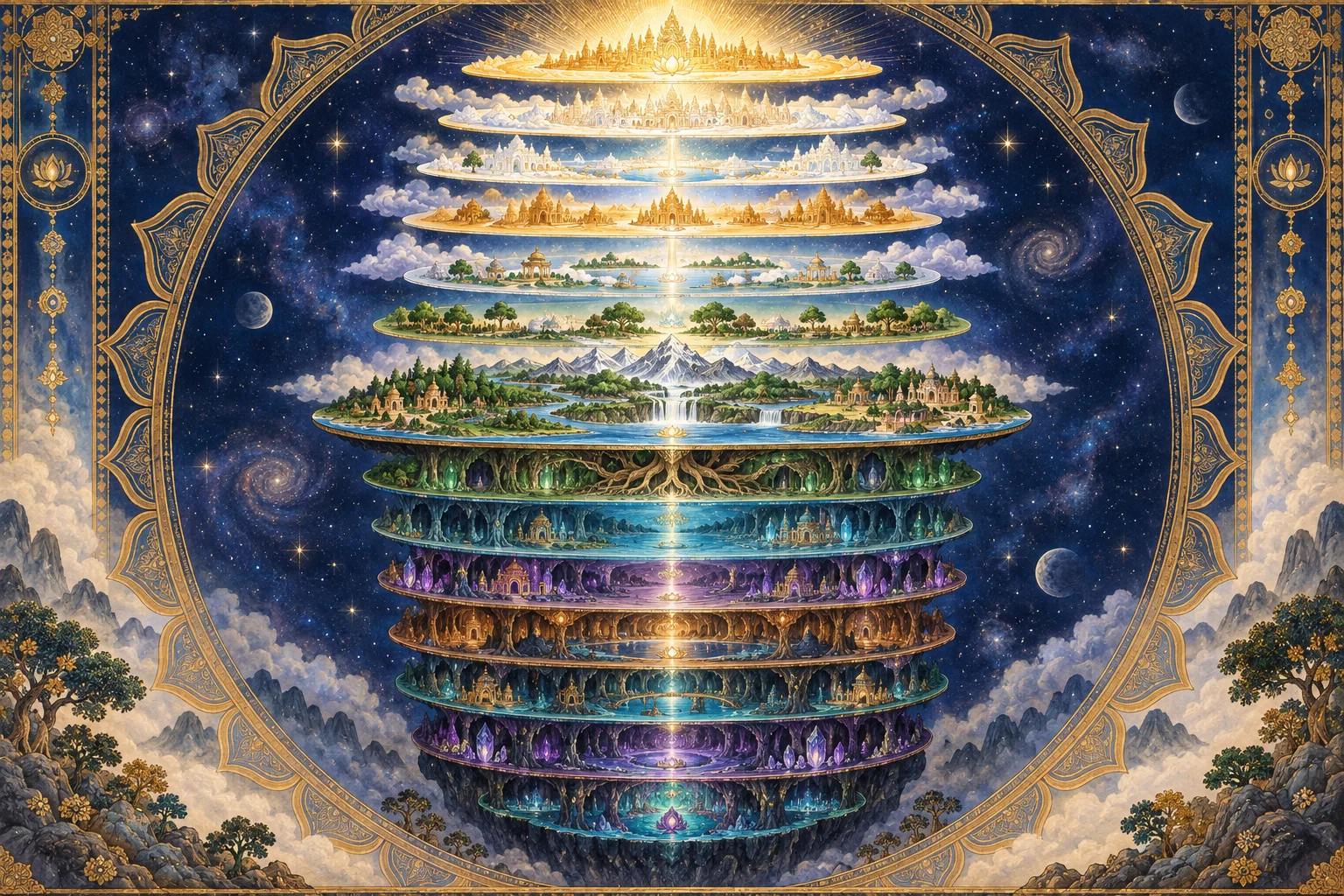
The 14 lokas in Hinduism are a traditional way of describing the ordered realms of the cosmos. In the most familiar Puranic arrangement, there are seven upper lokas—Bhu, Bhuvar, Svar, Mahar, Jana, Tapa, and Satya—and seven lower lokas—Atala, Vitala, Sutala, Talatala, Mahatala, Rasatala, and Patala.
The Sanskrit word loka can mean a world, realm, sphere, or domain of experience. It does not always mean a physical planet. The fourteen-loka model belongs to Hindu sacred cosmology and should not be presented as if it were a modern astronomical chart. Different texts, schools, and teachers may understand its geography literally, symbolically, spiritually, or through a combination of these approaches.
The 14 lokas in order
The usual sequence is shown below, from the highest upper realm to the lowest lower realm:
| Order | Loka | Common English description |
|---|---|---|
| 1 | Satyaloka or Brahmaloka | Realm associated with Brahma and the highest beings within the manifested cosmos |
| 2 | Tapoloka | Realm associated with great ascetics and the power of tapas |
| 3 | Janaloka | Realm associated with spiritually advanced sages |
| 4 | Maharloka | Realm of great rishis or seers |
| 5 | Svarloka or Svargaloka | Celestial realm associated with devas and the fruits of merit |
| 6 | Bhuvarloka | Intermediate region between earth and the celestial sphere |
| 7 | Bhuloka or Bhurloka | The earthly realm and the human world |
| 8 | Atala | First of the seven lower realms in the common Puranic list |
| 9 | Vitala | Second lower realm |
| 10 | Sutala | Realm famously associated with King Bali |
| 11 | Talatala | Realm associated in some texts with Maya Danava |
| 12 | Mahatala | Realm associated with powerful serpent beings in Puranic accounts |
| 13 | Rasatala | Realm associated with Daityas and Danavas in several accounts |
| 14 | Patala | Deepest of the seven lower realms in this arrangement |
“Upper” and “lower” help readers follow the traditional cosmic hierarchy. They should not automatically be translated as morally good and evil. In particular, the lower lokas are not simply seven versions of hell.
The seven upper lokas
1. Bhuloka: the earthly realm
Bhuloka (Bhū-loka or Bhūr-loka) is the realm of earth, embodied life, and ordinary human experience. Although it appears lowest in the upper group, many Hindu teachings give human birth special importance because it offers the capacity to choose, practise dharma, seek knowledge, and work toward liberation.
Bhuloka is where pleasure and difficulty, freedom and limitation, and knowledge and confusion are closely mixed. That makes it a field of action rather than an insignificant rung on a ladder. Read what karma means for the relationship between action, intention, and consequence.
2. Bhuvarloka: the intermediate region
Bhuvarloka (Bhuvaḥ-loka) is commonly described as the region between the terrestrial and celestial worlds—the atmosphere, mid-space, or subtle intermediate sphere. Texts associate it with different classes of beings, so a single fixed population should not be assumed.
The familiar sacred utterance Bhūr Bhuvaḥ Svaḥ invokes Bhu, Bhuvar, and Svar together. These three form one influential version of the triloka, or three worlds. They also open the Gayatri Mantra.
3. Svarloka: the celestial realm
Svarloka, also called Svargaloka or simply Svarga, is the celestial realm associated with Indra, the devas, and refined enjoyment earned through meritorious action. It is often what English retellings call “heaven,” but that translation needs care.
Svarga is normally described as impermanent rather than the final spiritual goal. When the merit supporting an experience is exhausted, rebirth may follow. This distinguishes a pleasant celestial destination from moksha, which means freedom from the cycle of rebirth.
4. Maharloka: the realm of great sages
Maharloka is associated with maharishis, the great seers. Puranic accounts position it between the more changeable lower three upper worlds and the higher contemplative realms. Some cosmological descriptions say its residents move to a higher realm during a periodic dissolution.
This detail expresses an important theme: even cosmic realms operate within vast cycles of manifestation and withdrawal. Their time scales may be immense, but duration is not the same as timelessness.
5. Janaloka: the realm of spiritually advanced beings
Janaloka is commonly linked with highly accomplished sages, including Brahma’s mind-born sons in some accounts. Its name is related to jana, “people” or “beings,” though the loka’s significance comes from the advanced spiritual status assigned to its inhabitants.
Descriptions here are briefer than popular summaries sometimes suggest. It is better to preserve that modesty than to fill gaps with a detailed invented geography.
6. Tapoloka: the realm of tapas
Tapoloka is associated with beings established in tapas: concentrated spiritual discipline, contemplative intensity, or ascetic power. The Sanskrit word does not mean suffering for its own sake. It can suggest the inner heat through which attention is purified and directed.
Tapoloka therefore represents a mode of existence oriented toward contemplation rather than sensory enjoyment. Individual traditions may explain its residents and place in cosmic time differently.
7. Satyaloka: the highest world in the scheme
Satyaloka, often identified with Brahmaloka in this context, stands at the summit of the fourteen-world arrangement. It is associated with Brahma, truth, subtle knowledge, and extraordinarily long-lived beings.
Highest does not always mean absolutely beyond samsara. Bhagavad Gita 8.16 teaches that the worlds up to Brahma’s realm are subject to return, while union with the Divine ends rebirth. See Bhagavad Gita 8.16 and this introduction to moksha for that distinction.
The seven lower lokas
The lower realms are often called adholokas or collectively patala. The Bhagavata Purana gives a richly detailed account, while other Puranas preserve related but not always identical lists and descriptions. Their imagery includes palaces, gardens, jewels, serpentine beings, pleasure, power, and spiritual danger—not merely darkness and punishment.
1. Atala
Atala is the first realm below Bhuloka in the commonly used list. Puranic descriptions connect it with extraordinary enjoyments and enchanted forms of worldly attraction. Its lesson is not simply that pleasure is evil, but that fascination and power can bind awareness when they are separated from wisdom.
2. Vitala
Vitala is the second lower realm. Some accounts connect it with a form of Hara or Shiva and with remarkable forms of mineral wealth. Details differ across translations and texts, which is why short modern descriptions should not be treated as a universal creed.
3. Sutala
Sutala is associated with the generous asura king Bali. In the Vamana narrative, Vishnu measures the worlds in three strides, and Bali ultimately receives Sutala. The story makes this loka especially significant: a “lower” location can still be connected with devotion, divine protection, humility, and grace.
This is one reason a simple good-above, evil-below reading does not fit the tradition. The guide to Hindu deities provides context for Vishnu and other figures who appear across these narratives.
4. Talatala
Talatala is linked in the Bhagavata tradition with Maya Danava, the renowned architect and master of extraordinary constructions. Its imagery emphasizes technical power, illusion, and sophisticated material environments.
The association can be read as a reminder that brilliance and spiritual freedom are different achievements. Skill can create astonishing worlds without necessarily ending attachment.
5. Mahatala
Mahatala is described as a realm of powerful serpent beings or Nagas in several Puranic accounts. Naga imagery in Hindu traditions is complex: it can signify danger, guardianship, fertility, water, hidden treasure, or cosmic power. It should not be reduced to the modern idea of a monster-filled underworld.
6. Rasatala
Rasatala is associated with groups such as Daityas and Danavas in Puranic narratives. These categories belong to a broad sacred literature in which divine and anti-divine beings have long genealogies, rivalries, virtues, and failings. “Demon” is a convenient English word but can flatten that complexity.
The Samudra Manthan story illustrates how devas and asuras can participate in the same cosmic event rather than occupying a simple two-sided universe.
7. Patala
Patala is the deepest realm in the familiar sequence and is frequently connected with Nagas, splendour, jewels, and subterranean beauty. The word patala may also be used more broadly for the entire group of lower worlds, so context matters whenever it appears.
Patala is not automatically identical with Naraka. Naraka refers in many afterlife texts to punitive states or realms linked with the consequences of harmful actions. Puranic descriptions of Patala, by contrast, can portray an opulent world whose residents face attachment and spiritual limitation, not a chamber of eternal punishment.
Three worlds and fourteen worlds: why both appear
Hindu texts do not use only one cosmic map. The three worlds (triloka) may be expressed as earth, mid-space, and heaven—Bhu, Bhuvar, and Svar. In other contexts, triloka is used more broadly for celestial, terrestrial, and subterranean domains. The fourteen worlds expand the structure into a more detailed seven-above and seven-below arrangement.
These frameworks do not need to be forced into a single modern diagram. A text may select the scale appropriate to its prayer, narrative, ritual, or philosophical teaching. The three sacred utterances in the Gayatri Mantra, for example, serve a different purpose from a Puranic chapter describing the lower realms.
Are the 14 lokas symbolic or literal?
Hindu traditions do not give one mandatory modern answer. Readers have understood lokas in several overlapping ways:
- Cosmographic: real regions within a sacredly ordered universe;
- Karmic: destinations or conditions corresponding to actions and qualities;
- Psychological: patterns of awareness, desire, clarity, or bondage;
- Ritual and meditative: realms invoked in prayer, visualization, or contemplation;
- Theological: parts of a universe sustained by and contained within the Divine.
These readings can coexist for a practitioner. What should be avoided is claiming that a Puranic hierarchy has been scientifically located, or that it is merely a primitive version of current astrophysics. Sacred cosmology asks questions about meaning, consciousness, karma, time, and liberation; astronomy uses observation and mathematical models to study the physical universe. Respecting both requires keeping their methods distinct.
The cosmic form revealed in Bhagavad Gita chapter 11 offers another theological perspective: many beings and worlds are perceived within the Divine form. Bhagavad Gita 11.13 describes Arjuna seeing the whole universe gathered together.
What the fourteen lokas teach
The framework places ordinary human life inside a universe far larger than individual ambition. It also refuses to make pleasure, status, longevity, or celestial residence the same as liberation. A being may inhabit an astonishing realm and still remain within conditioned existence.
For a spiritual reader, the lokas can therefore teach three connected ideas:
- Actions have consequences: ways of living shape future experience.
- No worldly position is the final identity: high and low conditions change across vast cycles.
- Liberation is different from relocation: moksha is not simply moving to a more pleasant realm, but freedom from ignorance and compulsive rebirth.
This is why Hindu paths emphasize transformation through devotion, knowledge, selfless action, and meditation. The overview of bhakti, karma, and jnana yoga explains how these disciplines approach that goal.
Textual variations and responsible reading
The Vishnu Purana, Bhagavata Purana, and other cosmological texts share the widely recognized fourteen-world structure, but spelling, sequence, inhabitants, measurements, and interpretation can vary. Svar, Svarga, and Svah may appear in related contexts; Satyaloka and Brahmaloka may be used together; and patala can mean one realm or the lower group collectively.
Translations also make choices. Rendering every loka as “planet” can sound more physically specific than the Sanskrit requires, while translating deva and asura only as “god” and “demon” can erase nuance. When a precise doctrinal or ritual question matters, consult the Sanskrit text, more than one translation, and a teacher from the tradition you are studying.
The fourteen lokas are best approached as a sophisticated sacred framework with many centuries of interpretation—not as a single infographic that settles every question about the Hindu universe.
Frequently Asked Questions
What are the 14 lokas in Hinduism?
A widely known Puranic framework describes seven upper lokas—Bhu, Bhuvar, Svar, Mahar, Jana, Tapa, and Satya—and seven lower lokas—Atala, Vitala, Sutala, Talatala, Mahatala, Rasatala, and Patala. Spellings, descriptions, and occasional lists vary among texts and traditions.
Which loka is Earth in?
Earth and the human world are generally placed in Bhuloka, also called Bhur-loka. It is the first of the seven upper realms in the common fourteen-loka arrangement and sits at the meeting point between the higher and lower sequences.
Is Patala the same as hell?
Not in the standard Puranic description. Patala and the other lower lokas are subterranean or lower cosmic regions, sometimes portrayed as beautiful and prosperous. Naraka refers to punitive realms associated with the consequences of harmful action, although popular retellings sometimes blur the terms.
Are the lokas physical planets?
Loka can mean a world, realm, sphere, or domain of experience. Different interpreters read the lokas cosmographically, symbolically, spiritually, or in combined ways. They should not be presented as objects mapped or verified by modern astronomy.
What is the highest loka?
Satyaloka, often called Brahmaloka in this cosmological context, is placed highest in the common fourteen-loka scheme. Many Hindu teachings still regard even exalted cosmic realms as belonging to conditioned existence, while moksha is freedom from rebirth itself.