
🌅 Hindu Concepts
Satya Yuga: The Golden Age of Truth, Its Length, Features and Return
Satya Yuga, also called Krita Yuga, is the age of truth that opens every cycle of time in Hindu cosmology. Here is how long it lasts, what life was like, which avatars appeared, and when it is said to return.
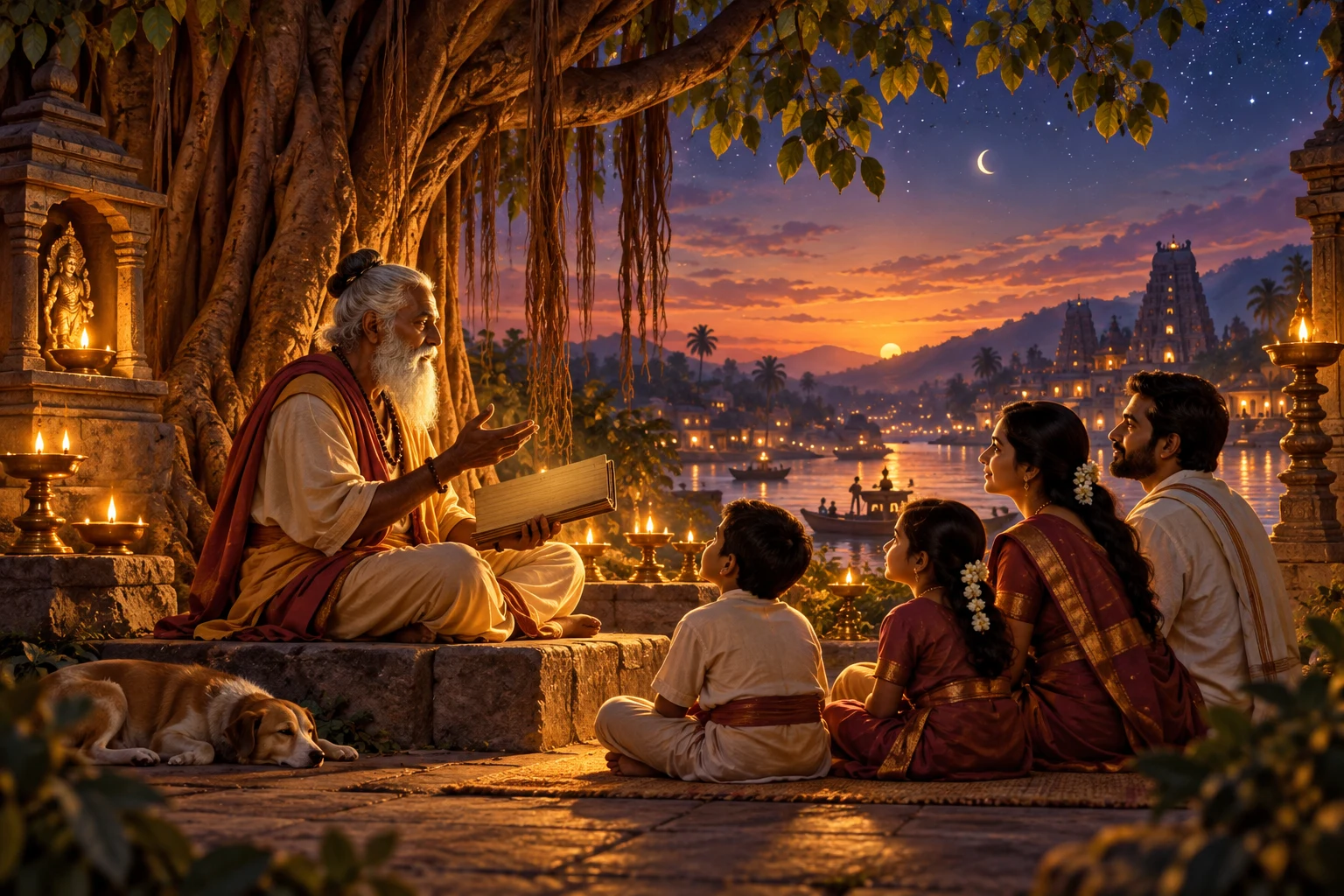
Satya Yuga (also Krita Yuga) is the first and golden age of the Hindu cycle of time — the age of truth. The Puranas give it 1,728,000 years. In it, dharma stands on all four legs: people are truthful, long-lived and free from disease and envy. It returns after each Kali Yuga, when Kalki restores dharma.
It is the starting point of every cosmic cycle, and the ideal against which the later ages are measured.
Satya Yuga at a glance
| Sanskrit | Satya Yuga (सत्ययुग), “age of truth”; Krita Yuga, “the accomplished age” |
| Position | First of the four yugas |
| Length | 4,800 divine years = 1,728,000 human years |
| Dharma | On four legs — complete |
| Main practice | Meditation (Bhagavata Purana); austerity (Manusmriti) |
| Human lifespan | Very long — often given as 100,000 years in later texts |
| Avatars | Matsya, Kurma, Varaha, Narasimha |
| Followed by | Treta Yuga |
| Returns after | Kali Yuga, with the coming of Kalki |
Satya Yuga in the four-yuga cycle
Hindu cosmology describes time as a repeating cycle of four ages (chatur-yuga or maha-yuga), whose lengths fall in the ratio 4 : 3 : 2 : 1:
| Yuga | Divine years | Human years | Dharma |
|---|---|---|---|
| Satya (Krita) | 4,800 | 1,728,000 | Four legs |
| Treta | 3,600 | 1,296,000 | Three legs |
| Dvapara | 2,400 | 864,000 | Two legs |
| Kali | 1,200 | 432,000 | One leg |
One divine year equals 360 human years. A full cycle lasts 4,320,000 years, and a thousand cycles make one day of Brahma, a kalpa. Each age includes a dawn and a dusk period (sandhya), counted in the totals above. For how this links to the worlds of Hindu cosmology, see the 14 lokas.
The image of dharma as a bull standing on four legs comes from texts such as the Bhagavata Purana and Manusmriti. Its legs are commonly named as truthfulness, austerity, compassion and purity (or cleanliness). In each later age one leg is lost, until in Kali Yuga dharma stands on truth alone.
What life was like in Satya Yuga
The Puranas, the Mahabharata and the Manusmriti describe Satya Yuga in similar terms:
- Truth and virtue came naturally; there was no need for laws or punishment.
- No disease, old age or decay troubled people as it does now, and lifespans were extremely long.
- No envy, pride, deceit or hatred; people lived in harmony.
- Nature was generous; the earth gave food without hard labour.
- One Veda and one dharma were shared by all, according to some accounts; division into many paths came later.
- Knowledge was direct: people saw truth through meditation rather than learning it from books.
The Mahabharata (Vana Parva) has Hanuman describe the four ages to Bhima, saying that in the Krita age “there was no buying or selling” and “the Vedas were not divided”.
Many of these descriptions are idealised, and their purpose is partly moral: they hold up a picture of what human life can be when dharma is complete. In the language of the three gunas, Satya Yuga is dominated by sattva — clarity and goodness. See the three gunas.
Spiritual practice in Satya Yuga
The Bhagavata Purana (12.3.52) gives each age its own path:
Kṛte yad dhyāyato viṣṇuṁ tretāyāṁ yajato makhaiḥ Dvāpare paricaryāyāṁ kalau tad dhari-kīrtanāt
“What was attained in Krita by meditating on Vishnu, in Treta by sacrifices and in Dvapara by worship, is attained in Kali by chanting the name of Hari.”
The Manusmriti (1.86) gives a slightly different list of chief virtues: austerity (tapas) in Krita, knowledge in Treta, sacrifice in Dvapara and giving (dana) in Kali. The two accounts agree that Satya Yuga’s path is inward and demanding, suited to an age of strong minds.
Avatars of Satya Yuga
The first four avatars of the Dashavatara are traditionally placed in Satya Yuga:
- Matsya, the fish, who saves Manu and the Vedas from the great flood.
- Kurma, the tortoise, who supports Mount Mandara at the churning of the ocean.
- Varaha, the boar, who lifts the earth from the cosmic ocean.
- Narasimha, the man-lion, who protects the child devotee Prahlada. See Narasimha Jayanti.
Even in the golden age, the stories show, there were demons and conflicts — but dharma was strong enough to overcome them.
When does Satya Yuga return?
The Puranas say that at the end of Kali Yuga, when righteousness has almost vanished, Vishnu will appear as Kalki. He will end the age of strife, and a new Satya Yuga will begin, with those who remain becoming pure and virtuous. The cycle then runs again.
On the traditional reckoning — with Kali Yuga beginning in 3102 BCE and lasting 432,000 years — the next Satya Yuga is more than 400,000 years away. Some modern teachers, such as Sri Yukteswar, proposed much shorter cycles, and some movements speak of a coming “golden age” within the present Kali Yuga. These are interpretations, not the standard Puranic account.
Satya Yuga and other “golden ages”
Many cultures imagine a lost golden age. The Greek poet Hesiod described ages of gold, silver, bronze, heroes and iron, declining like the yugas. Unlike Hesiod’s linear story, though, the Hindu view is cyclical: the golden age is not only behind us, it lies ahead, and the whole sequence repeats endlessly.
Why Satya Yuga matters
For most Hindus, Satya Yuga is not just a matter of chronology. It is an ideal — a reminder of the truthfulness, simplicity and inner peace that the tradition considers humanity’s natural state. Many teachers say that whenever a person lives in truth and meditation, they carry a little of Satya Yuga into any age.
Frequently Asked Questions
What is Satya Yuga?
Satya Yuga, also called Krita Yuga, is the first and best of the four ages in the Hindu cycle of time. It is the age of truth, when dharma stands firmly on all four legs, people are virtuous and long-lived, and there is no disease, envy or deceit.
How long is Satya Yuga?
The Puranas give Satya Yuga 4,800 divine years, or 1,728,000 human years, including its dawn and dusk periods. It is the longest of the four yugas: four times the length of Kali Yuga.
What is the main spiritual practice in Satya Yuga?
The Bhagavata Purana says that in Satya Yuga people attained God through meditation (dhyana). The Manusmriti says the chief virtue of the Krita age is austerity (tapas). In later ages, sacrifice, worship and finally chanting the divine name take its place.
Which avatars of Vishnu appeared in Satya Yuga?
Traditionally the first four avatars of the Dashavatara — Matsya the fish, Kurma the tortoise, Varaha the boar and Narasimha the man-lion — are placed in Satya Yuga. Accounts vary in some details.
When will Satya Yuga come again?
According to the Puranas, a new Satya Yuga begins at the end of the present Kali Yuga, when Kalki, Vishnu's tenth avatar, restores dharma. On the traditional reckoning this is over 400,000 years away, though some modern teachers propose shorter cycles.
Why is it called Krita Yuga?
Krita means 'done' or 'accomplished' and was the name of the winning throw in the ancient Indian dice game. The age is called Krita because in it everything is complete and nothing remains to be done; Satya means 'truth'.