
⏳ Hindu Concepts
Kali Yuga: Meaning, Duration, Signs and When It Ends
Hindu scriptures say we live in the Kali Yuga, the age of quarrel and decline. Here is what the Kali Yuga is, how long it lasts, when it began, its signs, and what the texts say about how it ends.
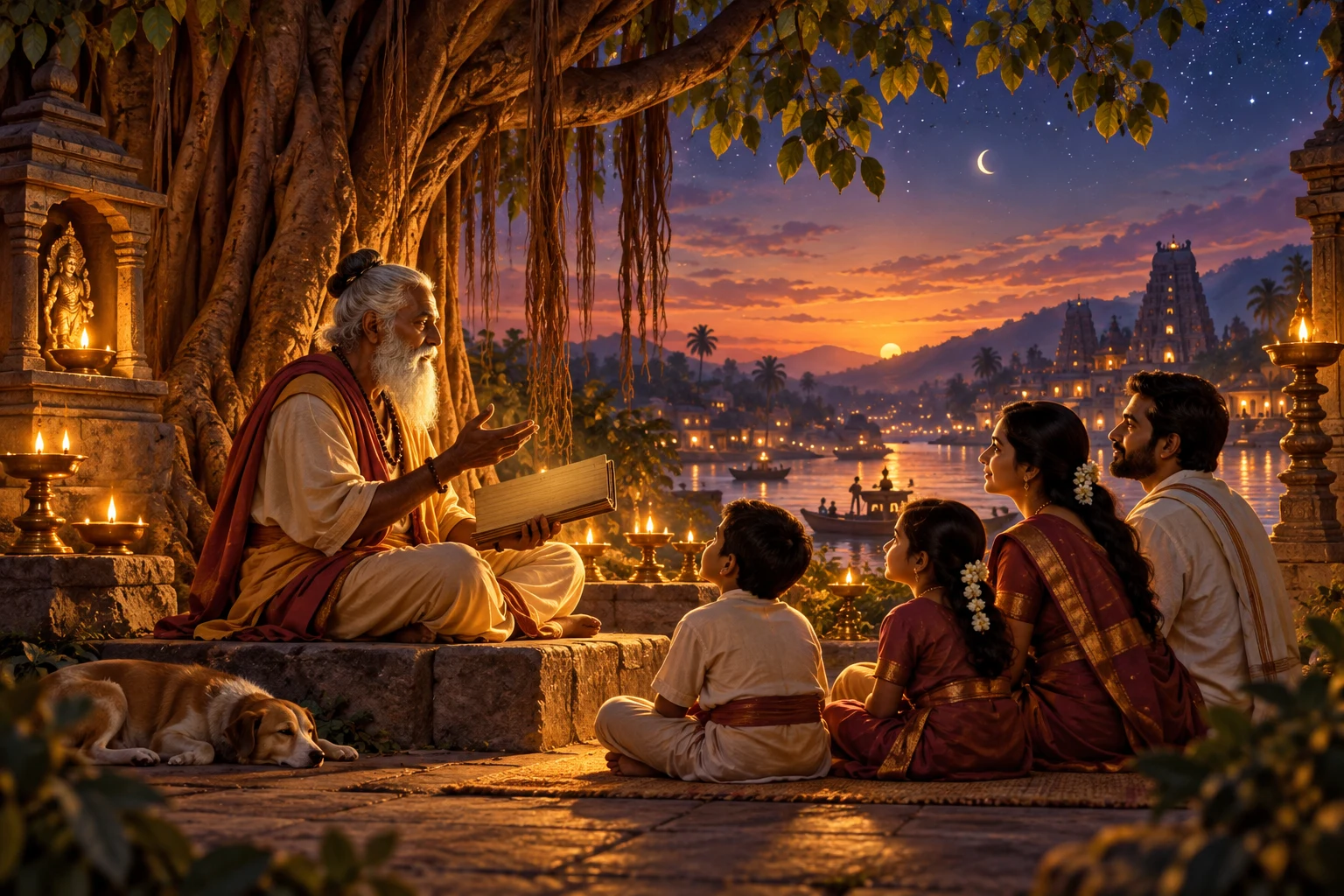
Kali Yuga is the fourth and darkest of the four ages in the Hindu cycle of time, following Satya, Treta and Dvapara. The Puranas give it 432,000 years, and tradition dates its start to 3102 BCE. It is the age of strife, in which dharma stands on one leg — and, according to tradition, the age we live in now.
It is not all gloom: the same texts say that in Kali Yuga, liberation is easiest, through simply remembering and chanting the name of God.
Kali Yuga at a glance
| Sanskrit | Kali Yuga (कलियुग) — “the age of Kali (strife)” |
| Position | Fourth of the four yugas |
| Length | 432,000 years (1,200 divine years) |
| Began | 3102 BCE, traditionally at Krishna’s departure |
| Dharma | On one leg — truthfulness alone remains, and that weakened |
| Main spiritual practice | Chanting the name of God (nama-sankirtana) |
| Ends with | The coming of Kalki, Vishnu’s tenth avatar |
| Followed by | A new Satya Yuga |
What does “Kali” mean?
The word kali (कलि) means strife, quarrel or discord. It is also the name of the losing throw in the ancient dice game, while krita, the winning throw, is another name for the first age. The ages are thus named like dice: from the perfect throw to the worst.
Kali is also personified as a demon, the spirit of the age. He is not the goddess Kālī (काली), whose name has a long “ī” and means “the dark one” or “she who is time”. The similarity in English spelling causes frequent confusion. For the goddess, see powerful Kali mantras.
The four yugas
Hindu cosmology describes time as a repeating cycle of four ages, together called a maha-yuga or chatur-yuga:
| Yuga | Length (human years) | Dharma | Notable avatar |
|---|---|---|---|
| Satya (Krita) | 1,728,000 | Four legs | Matsya, Kurma, Varaha, Narasimha |
| Treta | 1,296,000 | Three legs | Vamana, Parashurama, Rama |
| Dvapara | 864,000 | Two legs | Krishna |
| Kali | 432,000 | One leg | Kalki (to come) |
The total is 4,320,000 years. A thousand such cycles make one day of Brahma, a kalpa. Each yuga is preceded and followed by a twilight period (sandhya and sandhyamsha), which are included in these figures. See the ten avatars of Vishnu for the avatars of each age.
When did Kali Yuga begin?
Indian astronomers, following Aryabhata (5th–6th century CE), placed the start of Kali Yuga at midnight between 17 and 18 February 3102 BCE, when they calculated that the planets were in conjunction. The Puranas link the moment to Krishna’s departure from the world after the Mahabharata war; the Bhagavata says Kali entered the world as soon as Krishna’s feet left it.
Traditional calendars still count the Kali Yugabda, the year of the Kali era. In 2026, about 5,128 years of Kali Yuga have passed, leaving roughly 427,000 years on the traditional reckoning.
The signs of Kali Yuga
The fullest descriptions come from the Bhagavata Purana (Book 12), the Vishnu Purana (Book 6) and Markandeya’s prophecy in the Mahabharata (Vana Parva). Among the signs they list:
- Wealth alone becomes the measure of a person’s worth, birth and learning.
- Rulers become greedy and plunder their subjects like thieves.
- Truthfulness, mercy, cleanliness and patience decline day by day.
- Lifespans and strength shrink; people suffer from hunger, drought and disease.
- Relationships are based on convenience; families quarrel over property.
- Religion becomes outward show — wearing signs of holiness without inner discipline.
- Teachers and elders are not respected, and learning is sold.
Readers in every century have recognised their own times in these lists, which is part of their power.
Kali and King Parikshit
The Bhagavata Purana (1.17) tells how King Parikshit, Arjuna’s grandson, caught Kali — dressed as a king — beating a bull (Dharma) and a cow (the Earth). When Kali surrendered and begged for a place to live, Parikshit allowed him only where there was gambling, intoxication, illicit sex and slaughter, and, at his further request, gold (wealth gained wrongly). These are traditionally the places where Kali’s influence is strongest.
The one great virtue of Kali Yuga
The Bhagavata (12.3.51) adds a striking consolation:
Kaler doṣa-nidhe rājann asti hy eko mahān guṇaḥ Kīrtanād eva kṛṣṇasya mukta-saṅgaḥ paraṁ vrajet
“O King, this age is an ocean of faults, but it has one great virtue: simply by chanting the name of Krishna, one is freed and reaches the Supreme.”
The next verse says that what was attained by meditation in Satya Yuga, by sacrifice in Treta and by temple worship in Dvapara is attained in Kali Yuga by chanting God’s name. This idea underlies the Hare Krishna maha mantra, which the Kali-Santarana Upanishad presents as the remedy for the age. The same reasoning is given for why Ved Vyasa divided the Vedas and composed the Puranas: to make wisdom accessible to people of a weaker age.
How Kali Yuga ends
The Puranas say that at the end of Kali Yuga, when dharma has almost vanished, Vishnu will appear as Kalki in the village of Shambhala, riding a white horse and carrying a sword. He will destroy the wicked and restore righteousness, and a new Satya Yuga will begin. The cycle of the yugas then continues.
Other views of the yuga timeline
Not everyone accepts the 432,000-year figure literally:
- Sri Yukteswar, in The Holy Science (1894), proposed a 24,000-year cycle of ascending and descending ages, placing humanity in an ascending Dvapara Yuga since about 1700 CE.
- Some scholars suggest the original figures were in human years (12,000 years for the whole cycle) and were later multiplied by 360.
- Many teachers read the yugas mainly as a description of inner and moral states, not just of calendar time.
These are minority or interpretive views; mainstream Puranic tradition holds to the long reckoning.
Living well in Kali Yuga
Tradition does not ask people to despair. It asks them to keep dharma as best they can, practise compassion and honesty, and turn to the simplest practice of all — remembering God’s name. In that sense, the darkest age is also the one in which the door is most open.
Frequently Asked Questions
What is Kali Yuga?
Kali Yuga is the fourth and last of the four ages (yugas) in the Hindu cycle of time, after Satya, Treta and Dvapara. It is described as an age of quarrel and moral decline, in which dharma stands on only one leg. According to tradition, it is the age we live in now.
How long is Kali Yuga?
The Puranas give Kali Yuga a length of 432,000 human years (1,200 divine years of 360 human years each), including its twilight periods. It is the shortest of the four yugas: Dvapara is twice as long, Treta three times and Satya four times.
When did Kali Yuga start?
Traditional Indian astronomy, following Aryabhata, dates the start of Kali Yuga to 18 February 3102 BCE. It is linked with the departure of Krishna from the world after the Mahabharata war. On this reckoning, a little over 5,100 years have passed.
When will Kali Yuga end?
On the traditional 432,000-year reckoning, Kali Yuga has about 427,000 years left. The Puranas say that at its end Kalki, the tenth avatar of Vishnu, will appear to restore dharma and begin a new Satya Yuga. Some modern teachers propose much shorter cycles, but these are minority views.
What are the signs of Kali Yuga?
The Bhagavata and Vishnu Puranas list signs such as wealth being valued above virtue, rulers who plunder their people, decline in truthfulness, shorter lives, quarrels in families, hypocrisy in religion and the loss of respect for elders and teachers.
Is Kali Yuga related to Goddess Kali?
No. The age is named after Kali (कलि, short 'i'), the personified spirit of strife and the losing throw of the dice. The goddess is Kālī (काली, long 'ī'), a form of the Divine Mother. The names sound similar in English but are different words.