
🙏 Mythology
Dattatreya: The Guru God, His Birth Story, 24 Gurus and Mantras
Lord Dattatreya, son of the sage Atri and Anasuya, is revered as the Adi Guru who combines Brahma, Vishnu and Shiva. Here is his birth story, the lesson of his 24 gurus, his symbols and how devotees worship him.
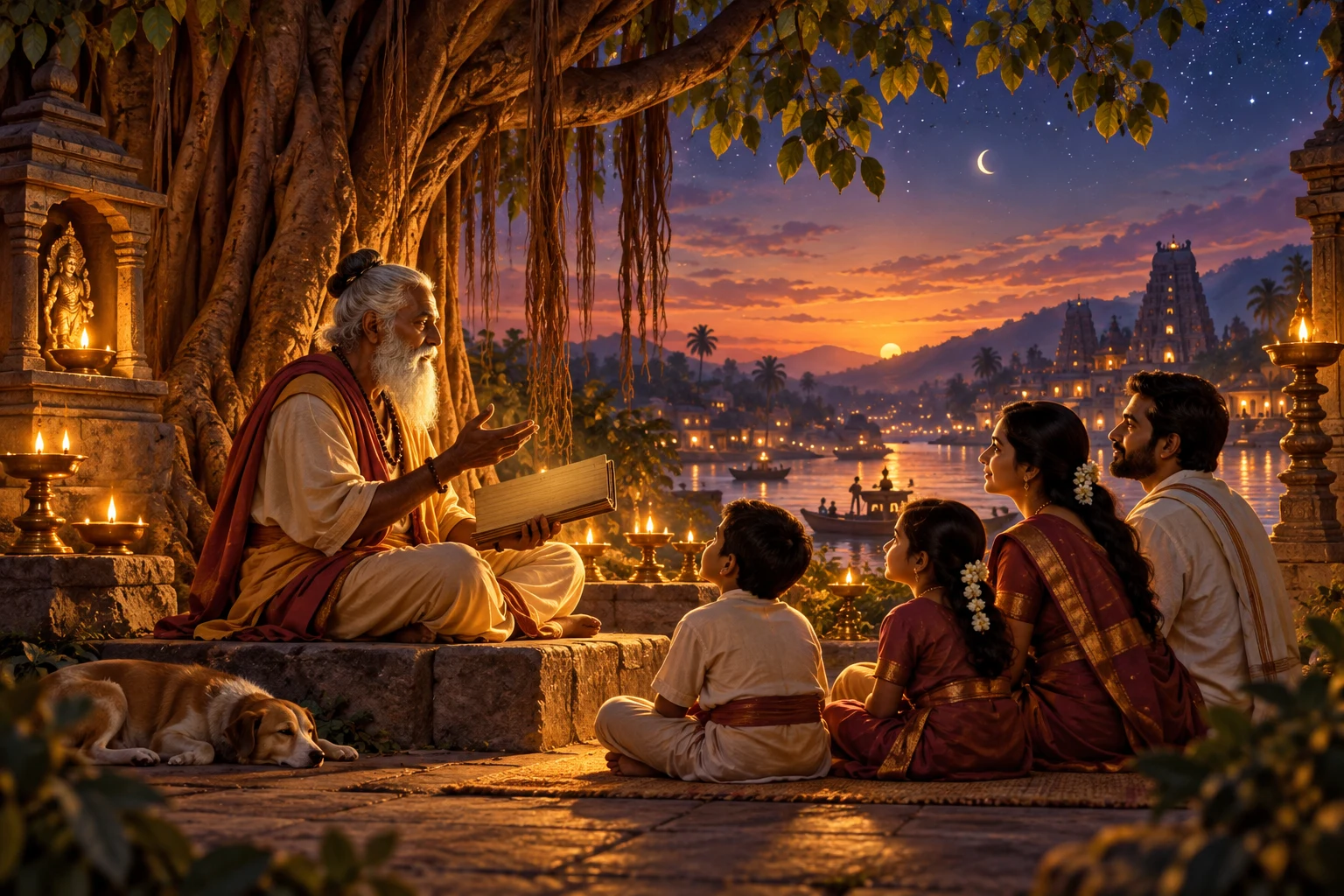
Dattatreya is the Hindu guru god, revered as the Adi Guru, the first teacher of yoga and self-knowledge. Son of the sage Atri and Anasuya, he unites Brahma, Vishnu and Shiva in one form with three heads and six arms. He is famous for learning from 24 teachers in nature; Datta Jayanti falls on Margashirsha Purnima.
His name combines datta, “given”, and atreya, “son of Atri”: the gods gave themselves as Atri’s son.
Dattatreya at a glance
| Parents | Sage Atri and Anasuya |
| Identified with | The Trimurti — Brahma, Vishnu and Shiva; counted by the Bhagavata Purana among Vishnu’s incarnations |
| Form | Three heads, six arms, standing or seated under an audumbar (cluster fig) tree |
| Companions | Four dogs and a cow |
| Role | Adi Guru, model of the avadhuta (free, renounced sage) |
| Texts linked with him | Bhagavata Purana Book 11 (24 gurus), Avadhuta Gita, Tripura Rahasya, Guru Charitra |
| Festival | Datta Jayanti, Margashirsha Purnima (23 December in 2026) |
The birth of Dattatreya
Anasuya, wife of the sage Atri, was so renowned for her purity and devotion that the goddesses Saraswati, Lakshmi and Parvati wished to test her. At their urging, Brahma, Vishnu and Shiva came to her hermitage disguised as mendicants and asked her to serve them food without wearing clothes.
Anasuya neither refused hospitality nor compromised her virtue. By the power of her devotion, she turned the three gods into infants, then fed and cared for them as a mother. When the goddesses came to beg for their husbands’ return, Anasuya restored the gods. Pleased, the Trimurti granted her a boon: they would be born as her sons.
Accounts differ on the details. In one widespread version the three gods are born as one child, Dattatreya. In others, Vishnu is born as Dattatreya, Brahma as Chandra (the moon) and Shiva as the sage Durvasa.
The symbols of Dattatreya
| Symbol | Common meaning |
|---|---|
| Three heads | Creation, preservation and dissolution held in one awareness |
| Six arms | Hold the conch and discus (Vishnu), trident and drum (Shiva), water pot and rosary (Brahma) |
| Four dogs | The four Vedas following the realised teacher; also mastery over the senses |
| Cow | Mother earth, dharma, or Kamadhenu |
| Audumbar tree | Sacred cluster fig under which he is worshipped |
| Ash, matted hair or simple dress | The renounced, free avadhuta |
The 24 gurus of Dattatreya
In the Bhagavata Purana (11.7–11.9), Krishna tells Uddhava the conversation between King Yadu and a joyful wandering sage, an avadhuta traditionally identified with Dattatreya. Asked how he is so content, the sage says he has learned from 24 teachers:
| Guru | Lesson |
|---|---|
| Earth | Patience; to serve others while bearing their weight |
| Air | To move through the world untouched by it |
| Sky | The self is all-pervading and unstained, like space |
| Water | Purity and the power to cleanse |
| Fire | To consume what comes without being tainted |
| Moon | Change belongs to the body, not to the self, as phases belong to the moon |
| Sun | To give freely, as the sun draws up water and returns it as rain |
| Pigeon | Excessive attachment leads to ruin |
| Python | To accept what comes without anxious striving |
| Ocean | To stay calm and deep in gain and loss |
| Moth | Not to be lured by appearances, as the moth by flame |
| Honeybee | To take the essence from many sources |
| Elephant | The danger of lust |
| Honey-gatherer | Hoarded wealth is taken by others |
| Deer | The danger of being captured through the ears by alluring sound |
| Fish | The danger of greed for taste |
| Pingala | Hope is misery; giving it up brings peace |
| Osprey | Letting go of what others fight over brings freedom |
| Child | Carefree innocence |
| Maiden | Solitude: one bangle makes no noise |
| Arrow-maker | Single-pointed concentration |
| Serpent | To live simply and alone, without a fixed home |
| Spider | The Lord creates and withdraws the world from himself |
| Wasp | We become what we meditate upon |
The message is that the whole world is a teacher for one who observes with an open mind.
Teachings associated with Dattatreya
- Avadhuta Gita — a radical non-dual text attributed to Dattatreya, proclaiming the self as pure, free and beyond all distinctions. See Brahman meaning and what is moksha.
- Tripura Rahasya — a dialogue in which Dattatreya teaches Parashurama about consciousness, recorded by the sage Haritayana.
- Jabala Darshana Upanishad — a yoga Upanishad in which Dattatreya teaches the eight limbs of yoga to the sage Sankriti.
The Datta tradition
In Maharashtra, Karnataka, Andhra Pradesh and Gujarat, the Datta sampradaya reveres a line of saints regarded as Dattatreya’s incarnations:
| Saint | Associated place |
|---|---|
| Sripada Sri Vallabha | Pithapuram, Andhra Pradesh |
| Sri Narasimha Saraswati | Ganagapur, Karnataka; Narsobawadi, Maharashtra |
| Manik Prabhu | Humnabad, Karnataka |
| Swami Samarth | Akkalkot, Maharashtra |
The Guru Charitra, a Marathi text composed by Saraswati Gangadhar, tells the lives of the first two and is read by devotees, often over seven days. Other important Datta shrines are at Mahur in Maharashtra, traditionally his birthplace, and the Girnar hills in Gujarat.
Mantras and worship
- Om Dram Dattatreyaya Namah — the beej mantra of Dattatreya; see what is a beej mantra.
- Shri Gurudev Datta — the simplest name chant, often repeated in Maharashtra.
- Digambara Digambara Shripada Vallabha Digambara — the most popular Datta bhajan line.
A simple Thursday practice: light a ghee lamp, offer yellow flowers or tulsi, chant one of the mantras 108 times, and feed a cow or a dog — an act of kindness that honours Dattatreya’s companions.
Datta Jayanti
Dattatreya’s birthday is celebrated on Margashirsha Purnima, which falls on 23 December 2026, just after Gita Jayanti. Devotees fast, read the Guru Charitra, sing bhajans and visit Datta temples. See the autumn Hindu festivals 2026 guide for the season’s dates.
Frequently Asked Questions
Who is Lord Dattatreya?
Dattatreya is a Hindu deity and the supreme teacher (Adi Guru) of yoga and self-knowledge. He is the son of the sage Atri and his wife Anasuya, and is regarded as an incarnation of the Trimurti — Brahma, Vishnu and Shiva — in one form. The Bhagavata Purana counts him among the incarnations of Vishnu.
Why does Dattatreya have three heads?
The three heads represent Brahma, Vishnu and Shiva — the powers of creation, preservation and dissolution — united in one teacher. The idea is that the guru embodies all three and leads the student beyond them to the one reality.
What are the 24 gurus of Dattatreya?
In the Bhagavata Purana (Book 11), an avadhuta identified with Dattatreya tells King Yadu that he learned from 24 teachers in nature, including the earth, air, sky, water, fire, moon, sun, a pigeon, a python, the ocean, a moth, a honeybee, an elephant, a deer, a fish, a child and a spider. Each taught him a lesson about detachment and wisdom.
Why are dogs shown with Dattatreya?
Dattatreya is usually shown with four dogs and a cow. The four dogs are commonly said to represent the four Vedas, which follow the realised teacher, and the cow stands for the earth, dharma or the wish-fulfilling Kamadhenu.
What is the Dattatreya mantra?
Widely used mantras include the beej mantra 'Om Dram Dattatreyaya Namah', the name chant 'Shri Gurudev Datta', and the bhajan line 'Digambara Digambara Shripada Vallabha Digambara'. Longer hymns include the Dattatreya Stotram and the Guru Charitra.
When is Datta Jayanti 2026?
Datta Jayanti, Dattatreya's birthday, is observed on Margashirsha Purnima, the full moon of the month of Margashirsha. In 2026 it falls on 23 December.