
🚪 Festivals
Vaikuntha Ekadashi 2026: Date, Parana Time, Puja Vidhi and Meaning
Vaikuntha Ekadashi falls on Sunday, 20 December 2026, the same day as Mokshada Ekadashi and Gita Jayanti. Here is the date, parana time, the opening of the Vaikuntha Dwaram, the Padma Purana story and how to keep the vrat.
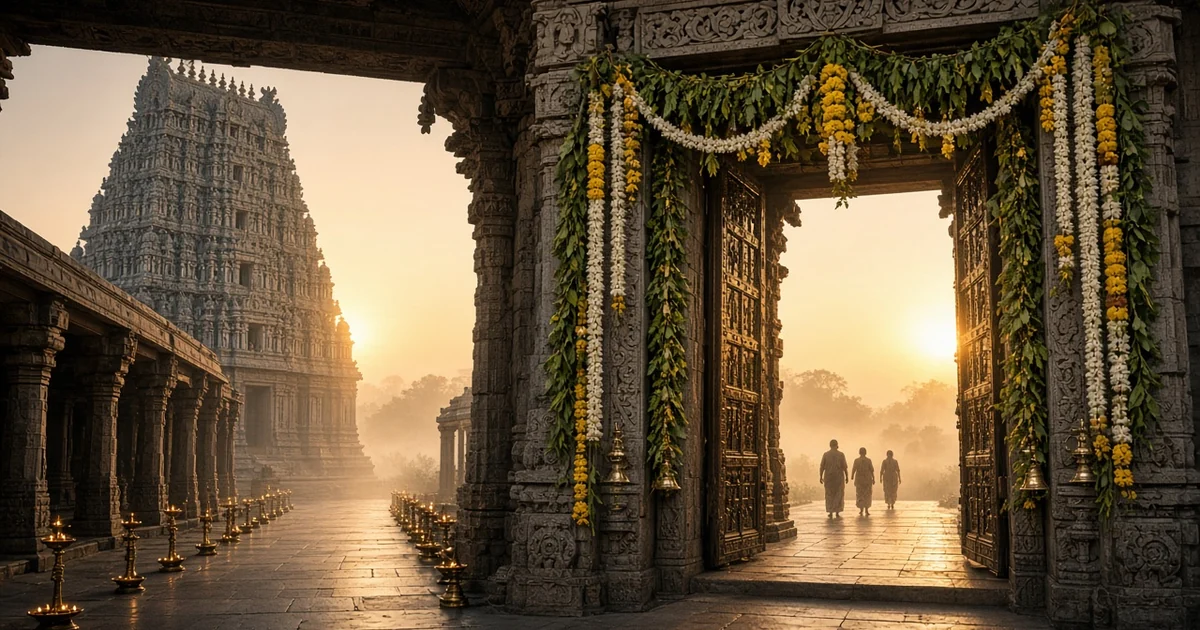
Vaikuntha Ekadashi 2026 falls on Sunday, 20 December, and the fast is broken on Monday, 21 December, between about 7:10 am and 9:13 am in New Delhi. It is the Shukla Ekadashi of Margashirsha, and in 2026 it coincides with Mokshada Ekadashi and Gita Jayanti. In South Indian Vaishnava temples this is the day the Vaikuntha Dwaram, the northern gateway, is opened.
Vaikuntha Ekadashi 2026 date and parana time
| Detail | 2026 (New Delhi, unless noted) |
|---|---|
| Vaikuntha Ekadashi | Sunday, 20 December 2026 |
| Also observed as | Mokshada Ekadashi; Gita Jayanti; Mukkoti Ekadashi |
| Ekadashi tithi | About 10:09 pm on 19 December to 8:14 pm on 20 December |
| Parana (breaking the fast) | Monday, 21 December: New Delhi about 7:10–9:13 am; Chennai 6:26–8:43 am; Hyderabad 6:41–8:55 am; Bengaluru 6:37–8:53 am |
| Dwadashi ends | About 5:36 pm on 21 December |
| Lunar month | Margashirsha Shukla Ekadashi (Purnimanta); in the Amanta calendar the same day is Margashirsha Shukla Ekadashi as well |
| Previous Ekadashi | Utpanna Ekadashi, Friday, 4 December 2026 |
This year Ekadashi is the tithi at sunrise only on 20 December, so Indian panchangs give one date for householders and Vaishnava communities alike. Clock times shift with the local sunrise, and outside India the date itself can move, so check a panchang for your city. Parana should be done after sunrise on Dwadashi, after the period called Hari Vasara (the first quarter of Dwadashi), and before Dwadashi ends.
The date was checked against Drik Panchang for New Delhi and cross-checked with MyPanchang (Pandit Mahesh Shastri) and the ISKCON Bangalore festival calendar, all of which list Sunday, 20 December 2026 in India.
What Vaikuntha Ekadashi remembers
Vaikuntha is Vishnu’s abode. On this Ekadashi, Vaishnava tradition holds that the gates of that abode stand open, and that sincere worship, fasting and the act of walking through the temple’s northern gate are a way of turning toward Vishnu. The day falls in the solar month of Dhanurmasa (Margazhi in the Tamil calendar), which in 2026 begins on Dhanu Sankranti, 16 December. Early-morning Vishnu worship is already the custom of this season; Vaikuntha Ekadashi is its high point.
The same tithi is kept in North India as Mokshada Ekadashi, “the Ekadashi that grants liberation,” and as Gita Jayanti, the day remembered as the one on which Krishna taught the Bhagavad Gita to Arjuna. One calendar day therefore carries three intertwined observances. This page is for the Vishnu fast, the temple gateway and the Mokshada story. For a reading plan, use the Gita Jayanti 2026 study guide. A Hindi retelling of the vrat katha is on मोक्षदा एकादशी व्रत कथा.
If you are new to the fast itself, start with what Ekadashi is and why it is kept.
The Vaikuntha Dwaram
In many Vishnu temples, especially in Tamil Nadu, Andhra Pradesh, Telangana and Karnataka, a doorway on the northern side of the shrine — the Paramapada Vasal or Swarga Vasal — is opened only on this day, or is given special honour on this day. Devotees queue before dawn, pass through the gate, and then take darshan of Vishnu. The practice is particularly famous at Srirangam (Sri Ranganathaswamy), at Tirumala-Tirupati, and at large ISKCON and other Vaishnava temples across South India.
The gate is a ritual threshold, not a shortcut around a life of practice. Walking through it is an act of prayer: a public sign that one hopes to live, and to die, in remembrance of Vishnu. If you plan to visit a major temple, check the local queue arrangements and darshan timings a few days ahead; the crowds at Srirangam and Tirupati are very large.
At home, families who cannot go to a temple often place a small decorated doorway or a rangoli “gate” before the shrine, light a lamp, and recite a Vishnu hymn such as the Vishnu Sahasranama or Om Namo Bhagavate Vasudevaya.
The Mokshada Ekadashi story
The story that gives Mokshada Ekadashi its name is told in the Uttara Khanda of the Padma Purana, where Krishna narrates it to Yudhishthira. In brief, and in our own words:
In the city of Champaka (some later retellings also call it Gokula) there lived a righteous king named Vaikhanasa. One night he dreamed that his late father was suffering in a hellish realm and was calling to him for help. Distressed, the king asked learned brahmins what could be done. They sent him to the sage Parvata, who, after meditation, told him the cause: in a previous life the father had neglected dharma in his household — the Purana specifies that he had disregarded his wife during her fertile period and had failed in his duty through attachment to another wife — and was now reaping the result of that conduct.
The sage’s remedy was not a ritual of blame. He asked the king to keep the Shukla Ekadashi of Margashirsha, called Mokshada, with his whole household, and to dedicate the merit of the vow to his father. Vaikhanasa did so: he fasted, kept a night vigil, fed brahmins on Dwadashi and offered the fruit of the vrat to his father. The Purana describes a shower of flowers and the father’s appearance in a divine form, freed and blessing his son.
The point of the story, as the tradition tells it, is that the merit of this Ekadashi can be shared, including with one’s ancestors, and that a sincere vow can repair more than one’s own life. Popular retellings differ on small details of the city and the household; the core — a son’s fast offered for a father’s release — is stable. Recitation of a katha is a spiritual practice, not a description of any particular family’s fate, and it is not a substitute for the ordinary duties of care.
Vaikuntha Ekadashi vrat vidhi
- Dashami (19 December): eat a simple sattvic meal before sunset and avoid grains after that, so the fast begins cleanly.
- Morning of Ekadashi: bathe, clean the prayer space and take a sankalpa, stating the kind of fast you will keep. If you wish to offer the merit to a parent or ancestor, name them in the resolve.
- Puja: place an image of Vishnu or Krishna, or a Shaligram if your family keeps one. Offer water or panchamrit, sandalwood paste, yellow flowers, tulsi leaves (picked the day before, since tulsi is traditionally not plucked on Ekadashi), fruit, a ghee lamp and incense. Many families also place a copy of the Bhagavad Gita on the altar and honour it with a flower.
- Chant and read: recite Om Namo Bhagavate Vasudevaya (see the Vishnu mantra), read the Vishnu Sahasranama or a chapter of the Bhagavad Gita, and read or listen to the Mokshada katha. The hymn Bhaja Govindam is also a fitting companion to a day that remembers both Vishnu and the Gita.
- The gateway: if you are near a Vishnu temple, join the Vaikuntha Dwaram queue with patience. At home, sit before the shrine and offer the same prayer.
- Evening: perform aarti, such as Om Jai Jagdish Hare. Some devotees keep a night vigil with kirtan.
- Parana on 21 December: after the morning puja, break the fast within the local parana window, ideally with tulsi water and a light meal. Feeding someone or making a donation before you eat is a common practice.
Fasting rules and food
- Avoid: rice, wheat, pulses, beans and other grains. Many households also avoid onion and garlic.
- Allowed in a phalahar fast: fruit, milk, curd, paneer, nuts, sabudana, potatoes, sweet potatoes, and kuttu, singhara or rajgira flour, with rock salt.
- Types of fast: nirjala (without water), water only, fruit and milk only, or one fasting meal. Children, older people, pregnant women and anyone with a medical condition should keep a gentle fast or simply observe the prayer. Do not fast against medical advice.
Other observances around this day
Vaikuntha Ekadashi comes after Vivah Panchami on 14 December and Dhanu Sankranti on 16 December, and is followed three days later by Datta Jayanti and Annapurna Jayanti on Margashirsha Purnima, 23 December. The hymn for that second observance is the Annapurna Stotram. See every date in our list of Hindu festivals in December 2026, plan a Gita habit with the daily Gita reading plan, and explore more Vishnu mantras.
Date and parana times were checked against Drik Panchang for New Delhi and cross-checked with MyPanchang and the ISKCON Bangalore calendar. The story summary follows the Padma Purana, Uttara Khanda, in our own words.
Frequently Asked Questions
When is Vaikuntha Ekadashi in 2026?
Vaikuntha Ekadashi is on Sunday, 20 December 2026. In New Delhi, Ekadashi tithi begins at about 10:09 pm on 19 December and ends at about 8:14 pm on 20 December. Because Ekadashi prevails at sunrise only on 20 December, Indian panchangs list a single date this year for both Smarta and Vaishnava calendars.
What is the Vaikuntha Ekadashi parana time in 2026?
The fast is broken on Monday, 21 December 2026. Drik Panchang gives parana from about 7:10 am to 9:13 am in New Delhi, 6:26–8:43 am in Chennai, 6:41–8:55 am in Hyderabad and 6:37–8:53 am in Bengaluru. Dwadashi tithi lasts until about 5:36 pm on 21 December (the end moment is the same clock time across India). Confirm the window with a local panchang.
Is Vaikuntha Ekadashi the same as Mokshada Ekadashi and Gita Jayanti?
In 2026 they fall on the same day, Margashirsha Shukla Ekadashi, Sunday, 20 December. Mokshada is the usual North Indian name for this Ekadashi; Vaikuntha Ekadashi (also Mukkoti Ekadashi or Swarga Vathil Ekadashi) is how it is named in many South Indian Vaishnava temples. Gita Jayanti remembers the teaching of the Bhagavad Gita on the same tithi. The observances differ: one is a Vishnu fast and temple festival, the other is a day of Gita study.
What is the Vaikuntha Dwaram?
It is the ceremonial northern gateway of a Vishnu temple, also called the Paramapada Vasal or Swarga Vasal. On Vaikuntha Ekadashi the gate is opened and devotees walk through it, a practice especially well known at Srirangam, Tirupati and many other South Indian Vishnu temples. It is understood as a symbolic passage toward Vishnu's abode, Vaikuntha.
Why is it also called Mukkoti Ekadashi?
In Andhra Pradesh and Telangana the day is widely called Mukkoti Ekadashi. Mukkoti is often explained as three crores, a traditional way of speaking of the host of gods said to attend on Vishnu this day. In parts of Kerala and Tamil Nadu it is also called Swarga Vathil or Sorgavasal Ekadashi, 'the Ekadashi of the gate of heaven.'
What can I eat on Vaikuntha Ekadashi?
Those who fast avoid grains and beans, especially rice. Fruit, milk, curd, nuts, sabudana, potatoes, sweet potatoes and dishes of kuttu, singhara or rajgira flour with rock salt are common. Children, older people, pregnant women and anyone with a medical condition should keep a gentle fast or simply join the prayers.