
🇮🇳 Indian National Days
Indian National Days: A Guide to Civic Festivals and Observances
Last updated: September 26, 2026
India's civic calendar includes days of freedom, constitutional democracy, service, unity, education, and remembrance. Here is what each one means.
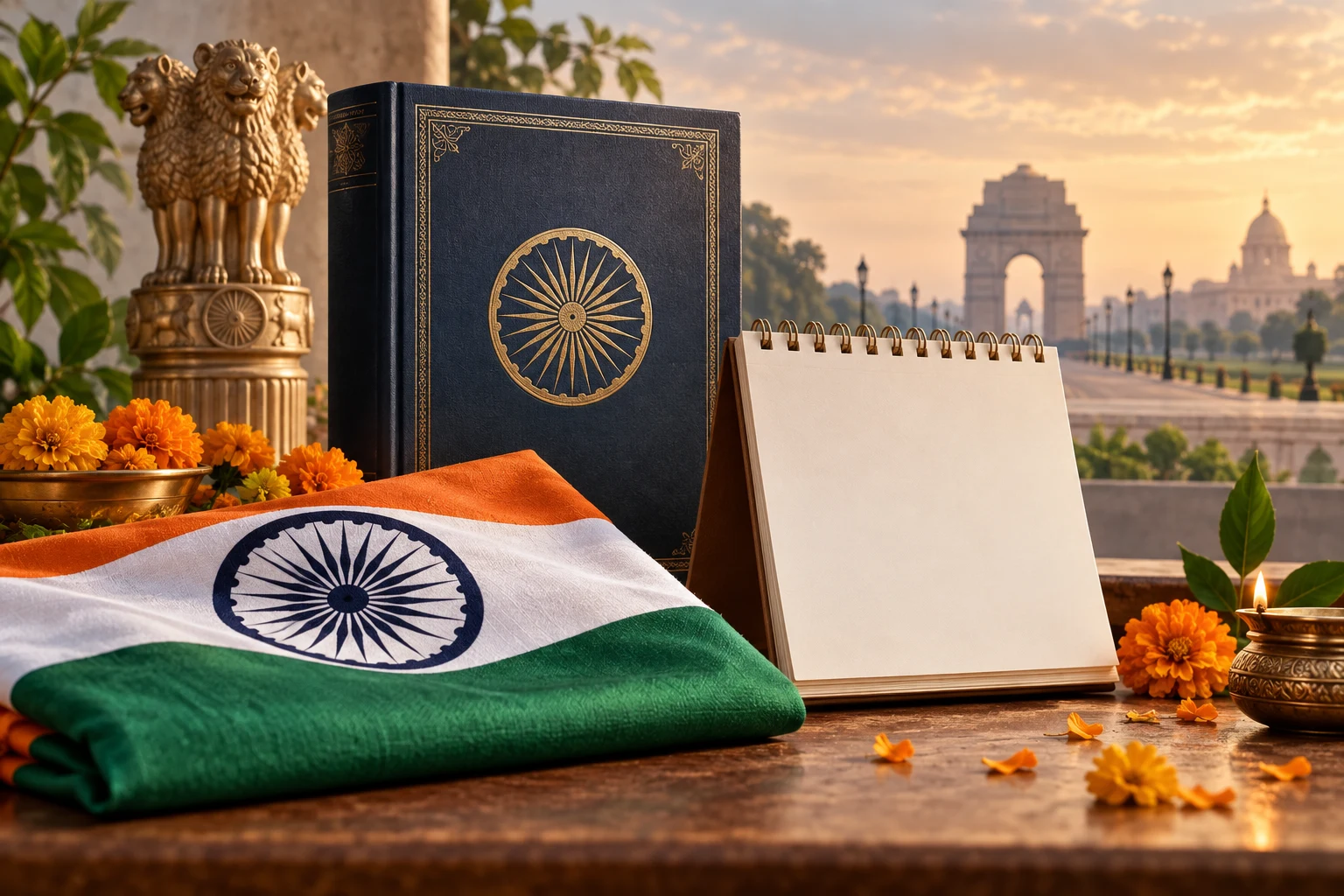
India’s calendar combines religious festivals, harvest celebrations, regional commemorations, and civic observances. These categories should not be collapsed into one another. A national or civic day belongs to public history and citizenship; it does not require adherence to a religion. Understanding what each date actually marks makes school programmes, workplace messages, and community ceremonies more accurate and inclusive.
India’s three national days are generally recognised as Republic Day, Independence Day, and Gandhi Jayanti. Several other dates are nationally important observances, but that does not necessarily make them nationwide public holidays.
Republic Day — 26 January
Republic Day marks the commencement of most provisions of the Constitution on 26 January 1950 and India’s emergence as a republic. The date also recalls the freedom movement’s Purna Swaraj declaration associated with 26 January 1930.
The President of India presides over the principal national celebration, which includes the Republic Day parade in New Delhi. Beyond the ceremony, the day invites citizens to examine the Preamble’s commitments to justice, liberty, equality, and fraternity.
Independence Day — 15 August
Independence Day commemorates the end of British colonial rule and the transfer of power in 1947. The Prime Minister hoists the national flag at the Red Fort during the central ceremony and addresses the nation.
It is a day to remember the many strands of the freedom movement—not only a short list of famous leaders—and to ask how political freedom is sustained through democratic participation and equal dignity.
Gandhi Jayanti — 2 October
Gandhi Jayanti marks the birth anniversary of Mohandas Karamchand Gandhi in 1869. Schools and institutions often organise prayer meetings, discussions of non-violence, and service or cleanliness activities.
Meaningful observance should go beyond repeating quotations. Study a specific campaign, debate the demands of non-violence, or resolve a conflict without dehumanising the other person.
Constitution Day — 26 November
Constitution Day, or Samvidhan Divas, commemorates the Constituent Assembly’s adoption of the Constitution on 26 November 1949. Most provisions came into force on 26 January 1950—a distinction that explains why both dates matter.
The day is well suited to reading the Preamble, learning about the Constituent Assembly, and discussing a Fundamental Right alongside a Fundamental Duty. The Government of India began formally observing 26 November as Constitution Day in 2015.
National Unity Day — 31 October
National Unity Day, or Rashtriya Ekta Diwas, is observed on the birth anniversary of Sardar Vallabhbhai Patel. It focuses on national integration and remembers Patel’s role in integrating princely states after independence.
Unity does not require uniformity. A strong activity might explore how India’s many languages, faiths, regions, and political opinions coexist under a shared constitutional order.
Teachers’ Day — 5 September
Teachers’ Day marks the birth anniversary of philosopher, teacher, and former President Dr Sarvepalli Radhakrishnan. The National Awards to Teachers are associated with the date.
Thank-you cards are welcome, but schools should also listen to teachers: what resources, preparation time, accessibility support, or professional respect would improve learning throughout the year?
Other civic dates worth understanding
National Voters’ Day on 25 January encourages electoral participation and voter awareness. National Science Day on 28 February commemorates the announcement of C. V. Raman’s discovery of the Raman effect. Children’s Day on 14 November, National Education Day on 11 November, and Armed Forces Flag Day on 7 December have their own histories and institutional contexts.
Because official themes and programmes can change annually, verify them through the responsible ministry or constitutional body. Do not copy an old year’s slogan into a new announcement.
How to organise a meaningful civic programme
Begin with one accurate historical question rather than a long sequence of speeches. Read a primary source, invite students to verify a claim, include regional and less-heard perspectives, and connect the day to one practical responsibility. Keep participation accessible to people of different religions, languages, abilities, and political views.
Handle the national flag according to the current Flag Code. Avoid single-use plastic flags that may be thrown away, do not let the flag touch the ground, and retire damaged flags respectfully. Patriotic expression gains credibility through care, not volume.
The official Constitution of India records the Preamble and adoption date. The Ministry of Education confirms that Teachers’ Day is observed on Dr Radhakrishnan’s birth anniversary. Together, these dates form a civic calendar of freedom, constitutional responsibility, remembrance, and public service.
Frequently Asked Questions
What are India's three national days?
The three occasions commonly recognised as India's national days are Republic Day on 26 January, Independence Day on 15 August, and Gandhi Jayanti on 2 October.
Is Constitution Day a national holiday in India?
Constitution Day is an important civic observance on 26 November, marking the Constitution's adoption in 1949, but it is not one of India's three national days or automatically a nationwide public holiday.
What is the difference between Republic Day and Constitution Day?
Constitution Day marks adoption on 26 November 1949. Republic Day marks the commencement of most constitutional provisions and India's emergence as a republic on 26 January 1950.
How should the Indian flag be handled during civic events?
Use the national flag with dignity and follow the current Flag Code of India. Avoid damaged flags and disposable uses likely to leave the flag on the ground or in rubbish.