
🕉️ Practice Guides
Nirvana Shatakam (Atma Shatakam): Sanskrit, Meaning and Recitation
Six verses in the Bhujangini metre, traditionally attributed to Adi Shankara: a clear 'neti neti' of body, mind and roles, ending in the refrain cidanandarupah shivoham shivoham.
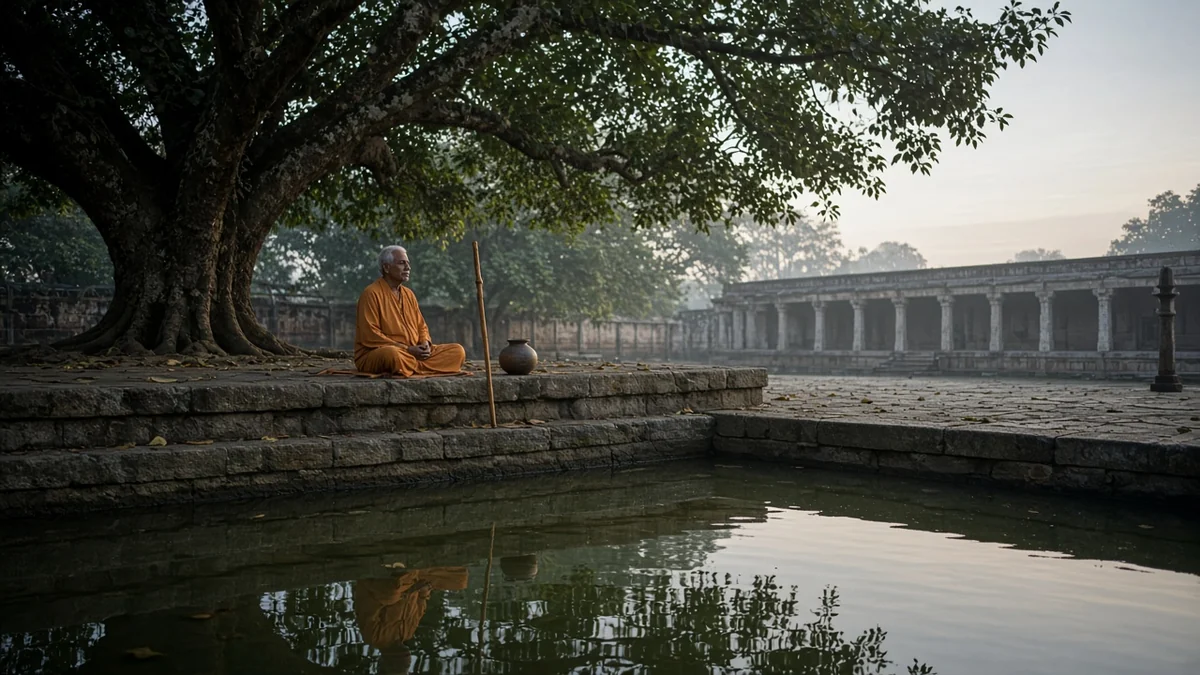
The Nirvana Shatakam, also called the Atma Shatakam, is a six-verse hymn traditionally attributed to Adi Shankaracharya. It is one of the clearest short statements of Advaita in devotional Sanskrit: the speaker sets aside mind, body, vital airs, family roles and even the four aims of life, and rests in a single refrain —
चिदानन्दरूपः शिवोऽहं शिवोऽहम्
cidānandarūpaḥ śivo’haṃ śivo’ham
“I am of the form of consciousness and bliss; I am Shiva, I am Shiva.”
Shiva here is the auspicious Self, not only the deity of the temple. The poem is a companion to other Shankara hymns on this site, especially Bhaja Govindam and the Dakshinamurthy Stotram. For the words the hymn is using, see Atman, Brahman and What is moksha.
The metre is Bhujangini. The public-domain Sanskrit below follows a widely recited recension; a few well-known variants are listed in the text notes.
Verse 1
मनोबुद्ध्यहङ्कारचित्तानि नाहं न च श्रोत्रजिह्वे न च घ्राणनेत्रे । न च व्योम भूमिर्न तेजो न वायुः चिदानन्दरूपः शिवोऽहं शिवोऽहम् ॥ १॥
manobuddhyahaṅkāracittāni nāhaṃ na ca śrotrajihve na ca ghrāṇanetre | na ca vyoma bhūmirna tejo na vāyuḥ cidānandarūpaḥ śivo’haṃ śivo’ham || 1||
Meaning. I am not the mind, the intellect, the ego-sense or memory; nor the ear and the tongue, nor the nose and the eyes. I am not space, nor earth, nor fire, nor air. I am of the form of consciousness and bliss; I am Shiva, I am Shiva.
Verse 2
न च प्राणसंज्ञो न वै पञ्चवायुः न वा सप्तधातुर्न वा पञ्चकोशः । न वाक्पाणिपादं न चोपस्थपायू चिदानन्दरूपः शिवोऽहं शिवोऽहम् ॥ २॥
na ca prāṇasaṃjño na vai pañcavāyuḥ na vā saptadhāturna vā pañcakośaḥ | na vākpāṇipādaṃ na copasthapāyū cidānandarūpaḥ śivo’haṃ śivo’ham || 2||
Meaning. I am not what is called the vital breath, nor the five winds; nor the seven constituents of the body, nor the five sheaths. I am not speech, hands or feet, nor the organs of procreation or excretion. I am of the form of consciousness and bliss; I am Shiva, I am Shiva.
The second line simply completes the body: the hymn refuses to identify the Self with any organ, including those of sex and elimination. The point is completeness, not shock.
Verse 3
न मे द्वेषरागौ न मे लोभमोहौ मदो नैव मे नैव मात्सर्यभावः । न धर्मो न चार्थो न कामो न मोक्षः चिदानन्दरूपः शिवोऽहं शिवोऽहम् ॥ ३॥
na me dveṣarāgau na me lobhamohau mado naiva me naiva mātsaryabhāvaḥ | na dharmo na cārtho na kāmo na mokṣaḥ cidānandarūpaḥ śivo’haṃ śivo’ham || 3||
Meaning. I have neither aversion nor attachment, neither greed nor delusion; I have no pride, nor any feeling of envy. I am not dharma, nor artha, nor kama, nor moksha. I am of the form of consciousness and bliss; I am Shiva, I am Shiva.
Even moksha is named among the four aims that the Self is not. The poem is not against a good life; it is saying that the ‘I’ it points to is not an object among other objects, not even the highest aim.
A common variant of the first line reads na me vai mado naiva mātsaryabhāvaḥ.
Verse 4
न पुण्यं न पापं न सौख्यं न दुःखं न मन्त्रो न तीर्थं न वेदा न यज्ञाः । अहं भोजनं नैव भोज्यं न भोक्ता चिदानन्दरूपः शिवोऽहं शिवोऽहम् ॥ ४॥
na puṇyaṃ na pāpaṃ na saukhyaṃ na duḥkhaṃ na mantro na tīrthaṃ na vedā na yajñāḥ | ahaṃ bhojanaṃ naiva bhojyaṃ na bhoktā cidānandarūpaḥ śivo’haṃ śivo’ham || 4||
Meaning. There is for me neither merit nor sin, neither pleasure nor pain; no mantra, no pilgrimage place, no Vedas, no sacrifices. I am not the food, nor the thing eaten, nor the eater. I am of the form of consciousness and bliss; I am Shiva, I am Shiva.
Verse 5
न मृत्युर्न शङ्का न मे जातिभेदः पिता नैव मे नैव माता न जन्म । न बन्धुर्न मित्रं गुरुर्नैव शिष्यः चिदानन्दरूपः शिवोऽहं शिवोऽहम् ॥ ५॥
na mṛtyurna śaṅkā na me jātibhedaḥ pitā naiva me naiva mātā na janma | na bandhurna mitraṃ gururnaiva śiṣyaḥ cidānandarūpaḥ śivo’haṃ śivo’ham || 5||
Meaning. I have no death, nor fear, nor distinction of birth; I have no father, no mother, no birth. I have no kinsman, no friend, no teacher, no disciple. I am of the form of consciousness and bliss; I am Shiva, I am Shiva.
Some prints read na me mṛtyuśaṅkā (“I have no fear of death”) as a single phrase in place of na mṛtyurna śaṅkā.
The verse does not dismiss parents, teachers or friends. It says that the Self the hymn is pointing to is not produced by those relations.
Verse 6
अहं निर्विकल्पो निराकाररूपो विभुत्वाच्च सर्वत्र सर्वेन्द्रियाणाम् । न चासङ्गतं नैव मुक्तिर्न मेयः चिदानन्दरूपः शिवोऽहं शिवोऽहम् ॥ ६॥
ahaṃ nirvikalpo nirākārarūpo vibhutvācca sarvatra sarvendriyāṇām | na cāsaṅgataṃ naiva muktirna meyaḥ cidānandarūpaḥ śivo’haṃ śivo’ham || 6||
Meaning. I am without alternative constructions, of formless form, and, being all-pervasive, I am everywhere, in all the senses. There is for me no attachment, nor liberation, nor anything measurable. I am of the form of consciousness and bliss; I am Shiva, I am Shiva.
Another widely printed close of the verse reads sadā me samatvaṃ na muktirna bandhaḥ — “for me there is always equanimity; there is neither liberation nor bondage.” If you are learning the hymn by heart, stay with one edition so the last line does not drift.
Text notes
The Sanskrit on this page was checked against the proofread public-domain edition of the Atma Shatakam at Sanskrit Documents (encoded and proofread by Giridhar; the file was last updated 29 June 2026). That page is cited as the edition used for verification. The English meanings are original to VedicVani and are not taken from that site.
A few points of wording:
- Shatakam here means a set of six, not a hundred verses.
- Pañca-kośa in verse 2 is the five sheaths of Vedanta (food, breath, mind, knowledge and bliss). Sapta-dhātu is the traditional set of seven bodily constituents.
- Verse 2 names upastha and pāyu plainly, so that no part of the body is left out of the denial.
- In verse 6, nirvikalpa means without the mind’s constructed alternatives; meya is ‘that which can be measured or known as an object.’
- Attribution to Shankara is traditional. Short Advaita hymns of this kind were also copied and slightly recast in later maths; the variants in verses 3, 5 and 6 are the usual sign of that life in recitation.
The hymn is a contemplative text. Reciting śivo’ham is a way of remembering the Self, not a claim about one’s biography, and not a substitute for a teacher or for ordinary responsibility.
Related reading
For companion Shankara hymns, see Bhaja Govindam, the Dakshinamurthy Stotram, the Soundarya Lahari, and the Guru Stotram. For the vocabulary the verses use, see Atman, Brahman, What is moksha and the purusharthas. Another Shankara hymn on this site is the Annapurna Stotram. A wider starting point is the beginner’s guide to Hindu mantras.
Frequently Asked Questions
What is the Nirvana Shatakam?
It is a six-verse Sanskrit hymn, also called the Atma Shatakam, traditionally attributed to Adi Shankaracharya. Each verse denies a set of identifications — mind, body, vital airs, social roles, even the four aims of life — and ends with the same refrain: I am of the form of consciousness and bliss; I am Shiva, I am Shiva.
Is Nirvana Shatakam the same as Atma Shatakam?
Yes. The two titles name the same six verses. Nirvana points to freedom from constructed identity; Atma points to the Self that remains when those constructions are set aside. Both names are in common use.
What does Shivoham mean in this hymn?
Shivoham means 'I am Shiva.' In this poem Shiva is the auspicious, formless Self — consciousness and bliss — not only the temple deity. The refrain can be read as a statement of Advaita: the true 'I' is that Self. It is a contemplative sentence, not a claim of personal grandeur.
Who wrote the Nirvana Shatakam?
The hymn is traditionally attributed to Adi Shankaracharya. Like several short Shankara stotras, it circulates in more than one recension, with small variants in verses 3, 5 and 6. The public-domain Sanskrit on this page follows a standard printed recension used for recitation, with those variants noted.
How should I recite the Nirvana Shatakam?
It is often recited slowly, in the early morning or at the close of meditation, one verse at a time, sitting quietly with the refrain. It is a support for self-inquiry, not a substitute for a teacher, study, or ordinary care. Learning the accents and metre from a living tradition is the best way to chant it.
How many verses does it have, and what is the metre?
There are six verses, so it is a shatakam in the older, shorter sense of the word (a group of six), not a hundred-verse poem. The metre is Bhujangini (also called Bhujangaprayata), a flowing metre often used in Shankara's shorter hymns.