
🔱 Deities
Devi Chamunda: Story, Meaning, Mantra and Symbolism
Chamunda is the fierce, protective form of Devi named after the defeat of Chanda and Munda. Her unsettling imagery confronts fear, mortality and destructive power without separating them from the Divine Mother.
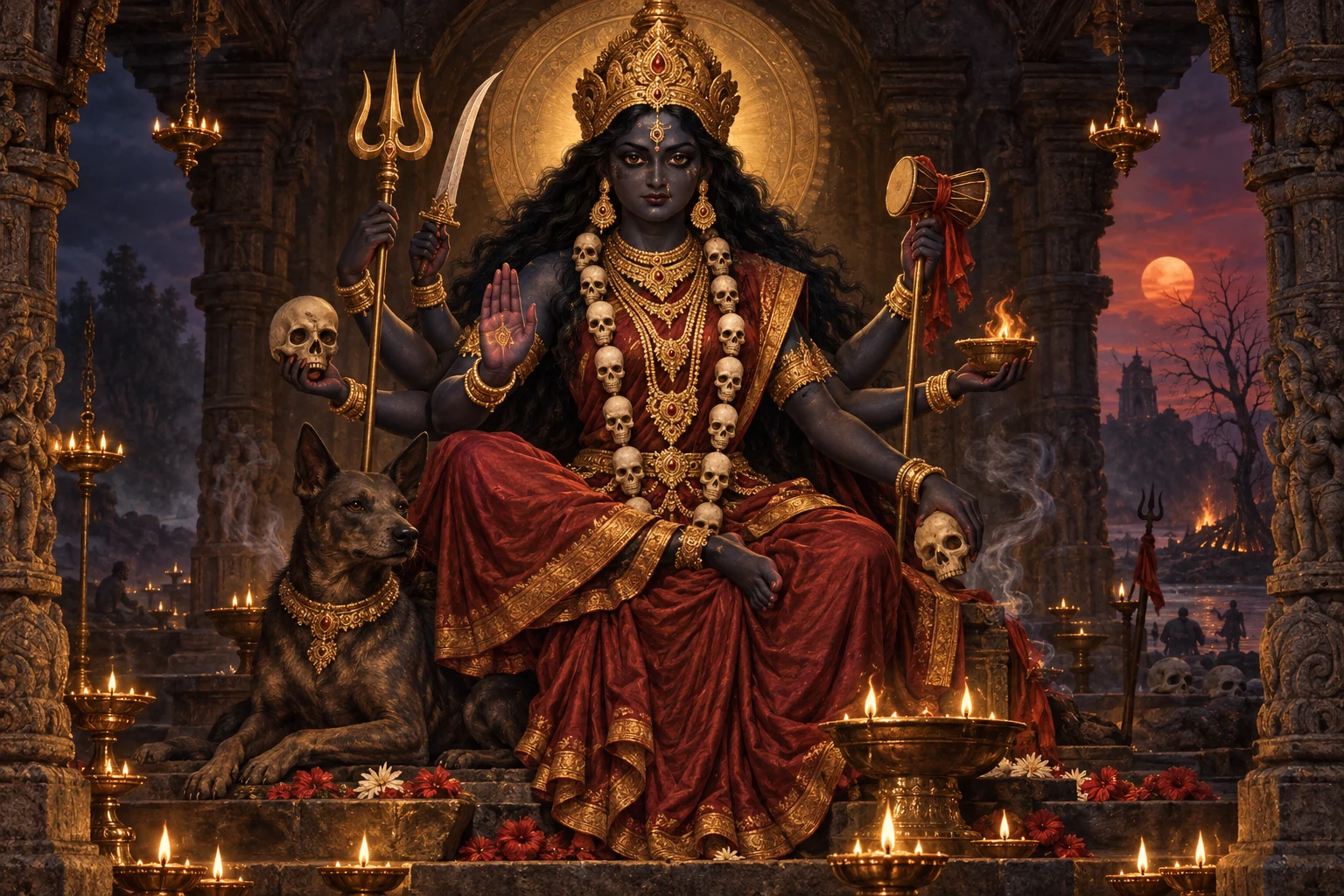
Devi Chamunda, also called Chamunda Mata or Chamundeshwari, is a fierce and protective form of the Divine Mother in Hindu tradition. Her best-known story appears in Chapter 7 of the Devi Mahatmya, where the goddess Kali defeats the asuras Chanda and Munda and is given the name Chamunda. She is also represented as one of the Matrikas, the powerful Mother goddesses found in Hindu texts, temples and sculpture.
Chamunda’s form can look severe: artists may show her with a skull garland, a trident, a skull cup, sunken features or a setting associated with death. These images are not simply meant to frighten. They place mortality, danger and the destruction of harmful forces inside the sacred power of Devi. Her iconography asks the devotee to face what ordinary life tries to hide.
Who is Goddess Chamunda?
Chamunda belongs to the broad world of Shakti, divine power understood as the Goddess. Depending on the text, region and lineage, she may be described as a form of Kali, a manifestation of Durga or Chandika, an independent protective goddess, or a member of the Sapta Matrikas. These descriptions overlap rather than fitting into one rigid family tree.
The Devi Mahatmya provides the clearest account of how she receives her name. This Sanskrit work is embedded in the Markandeya Purana and is also widely known as the Durga Saptashati or Chandi Path. Its 700 verses celebrate Devi as the supreme power who appears in different forms whenever order must be restored. See our guide to the Durga Saptashati for the structure and message of the full work.
The story of Chamunda, Chanda and Munda
The episode takes place during Devi’s conflict with the asura rulers Shumbha and Nishumbha. Their commanders Chanda and Munda advance with a large army toward Ambika, the radiant Goddess.
As Ambika becomes angry, a dark and formidable goddess springs from her brow. The text calls this emerging form Kali. She carries a sword and noose, wears a garland of heads and moves through the hostile army with overwhelming force. Chanda rushes toward her, but she defeats him with her sword. Munda follows and meets the same fate.
Kali then brings Chanda and Munda to Chandika. Pleased with her victory, Chandika declares that because she has overcome both Chanda and Munda, she will be renowned as Chamunda. This is the text’s direct explanation of the name.
The next chapter tells the battle with Raktabija. Chamunda takes part in that later conflict, but the two episodes should not be collapsed into one: her name is bestowed after the defeat of Chanda and Munda in Chapter 7; Raktabija’s defeat follows in Chapter 8.
The story is a battle narrative first. Devotional teachers also read its enemies inwardly—as pride, anger, confusion or impulses that multiply when fed. Those psychological readings can be meaningful, but they are interpretations of the story, not literal word-for-word definitions supplied by Chapter 7.
For more stories in which Devi’s many powers meet different forms of disorder, read Stories of Goddess Durga and the Durga Puja story and significance.
What does Chamunda mean?
In the narrative, Chamunda (Cāmuṇḍā) is formed from the names Chanda (Caṇḍa) and Munda (Muṇḍa). The name therefore remembers a specific act: the Goddess’s defeat of those two asuras.
Her wider meaning comes from what the story and image hold together:
- Protective power: her fierceness is directed against forces that threaten balance and sacred order.
- Courage before mortality: skeletal features and cremation-ground associations bring death into view instead of pretending it does not exist.
- Transformation: Chamunda represents the power that ends what is destructive so that renewal becomes possible.
- The wholeness of Devi: the gentle mother and the formidable warrior are not separate divinities competing with each other. Both belong to the Great Goddess.
These themes explain why devotees can approach a visually fearsome form as Maa, Mother. Her terror is not aimed at the sincere worshipper; it represents divine power unafraid to confront danger, decay and fear.
Why does Chamunda look fierce?
Chamunda’s iconography varies considerably by period and region. Historical sculptures may show an emaciated body, pronounced teeth, a garland of skulls or heads, a serpent, a trident, a sword, a skull cup and other attributes. The number of arms is not uniform. In Matrika panels she may appear at the end of the group, sometimes beside a jackal or another creature associated with liminal places.
The stark body reverses the usual artistic signs of abundance and youthful beauty. It makes impermanence visible. Her weapons signal active protection, while the skull and cremation imagery remind viewers that divine reality is present even where social comfort ends. Museum collections show how artists interpreted these features differently across centuries; no single modern illustration should be treated as the only canonical form.
Chamunda’s iconography is therefore best read symbolically and historically, not as a prescription for fear. The same Hindu tradition that celebrates auspicious beauty can use an unsettling sacred image to teach that nothing—not even death—lies outside Devi’s power.
Chamunda among the Sapta Matrikas
Chamunda frequently appears as one of the Sapta Matrikas, or Seven Mothers. A common list is Brahmani, Maheshwari, Kaumari, Vaishnavi, Varahi, Indrani and Chamunda, although names and the number of Mothers can vary in texts and regional traditions.
Temple panels often place the Mothers together, accompanied by figures such as Virabhadra and Ganesha. In this setting Chamunda is not an isolated image of destruction. She belongs to a collective of maternal powers who protect cosmic and social order. The word matrika means “little mother” or “mother,” making the combination of maternal care and fierce defense explicit.
Are Chamunda and Kali the same?
The most accurate short answer is: they are closely identified in the Chamunda story, but usage varies.
In the Devi Mahatmya, the goddess who emerges from Ambika’s brow is called Kali. After she defeats Chanda and Munda, Chandika names her Chamunda. On that narrative level, Chamunda is a name of this fierce Kali form. In later art and worship, Chamunda may be presented as a form of Kali, Durga or Devi and may also be worshipped with a distinct local identity.
This fluidity is common in Hindu goddess traditions. Names can indicate a deity, a manifestation, a title, a place-specific form or a particular divine action. It is safer to respect the description used by a community than to insist that every lineage use one classification. Our Kali mantra guide offers more context on Kali’s devotional forms.
A simple Chamunda mantra
For a straightforward prayer of reverence, one may use the name mantra:
ॐ चामुण्डायै नमः
Oṃ Cāmuṇḍāyai Namaḥ
Plain meaning: “Om, salutations to Chamunda.”
The ending -yai means “to” the Goddess in this salutation. English spellings vary—Chamundayai, Chamundaye and Chamundāyai can all be attempts to represent the Sanskrit चामुण्डायै—but listening to a knowledgeable reciter is more reliable than guessing from Roman letters.
Another famous formula is the Navarna Mantra:
ऐं ह्रीं क्लीं चामुण्डायै विच्चे
Aiṃ Hrīṃ Klīṃ Cāmuṇḍāyai Vicce
Many recitations prefix it with Om. Because this mantra includes bīja, or seed syllables, its pronunciation, ritual placement and interpretation differ by lineage. It is closely connected with Chandi and Shakta practice. Readers who want to undertake it as a formal sadhana should learn from a qualified teacher rather than assembling an advanced ritual from isolated internet instructions. Learn why seed syllables need context in What Is a Beej Mantra?.
How to pray to Chamunda at home
A simple household prayer does not require a specialized tantric rite:
- Clean the prayer space and sit quietly.
- Light a diya if it is safe to do so, or offer a flower and water.
- Remember Chamunda as the protective power of Devi.
- Recite Oṃ Cāmuṇḍāyai Namaḥ slowly 9, 11 or 27 times, or choose a steady count that suits your practice.
- Sit in silence and dedicate the prayer to courage, clarity and the welfare of others.
There is no universal rule that every devotee must use the same count, color, offering or weekday. Family custom and temple tradition take priority. More elaborate practices involving nyasa, a yantra, fire offerings or strings of bīja mantras belong within guided traditions. If you are new to japa, begin with the practical steps in How to Start a Daily Mantra Practice or a simple home puja.
Chamunda worship is especially visible within Shakta observance and during Navratri, but devotion is not limited to a festival. For a gentle introduction to the festival’s wider pattern, see What Is Navratri? and the beginner’s Navratri puja guide.
What devotees can learn from Chamunda
Chamunda does not offer spirituality as an escape from everything difficult. Her form places fear, loss and impermanence directly before the devotee. The lesson is not to imitate violence or seek control over others. It is to develop the steadiness to recognize destructive tendencies and meet them without denial.
That is why her story can remain meaningful beyond its battlefield setting. Chanda and Munda are first characters in a sacred narrative; in contemplative reading, their defeat can also prompt a personal question: what pattern of anger, pride or fear needs to stop receiving my energy? Chamunda’s power then becomes a model of clear limits, courageous action and transformation under the protection of the Divine Mother.
Text and art sources
- Devi Mahatmya, Chapter 7: The Slaying of Chanda and Munda — Sanskrit transliteration and English translation of the naming episode.
- Chamunda sculpture in The Metropolitan Museum of Art — a 10th–11th century example with a museum discussion of her iconography.
- The Seven Mother Goddesses at LACMA — a 9th-century Matrika panel and identification of Chamunda within the group.
Frequently Asked Questions
Who is Goddess Chamunda?
Chamunda is a fierce and protective form of the Divine Mother. In Chapter 7 of the Devi Mahatmya, Kali defeats the asuras Chanda and Munda and receives the name Chamunda from Chandika. She also appears in many traditions as one of the Sapta Matrikas, the Seven Mothers.
What does the name Chamunda mean?
In the Devi Mahatmya, the name joins Chanda and Munda, the two asuras defeated by Kali. Chandika declares that the goddess will therefore be known in the world as Chamunda.
Are Chamunda and Kali the same goddess?
They are closely related, but Hindu traditions do not always classify divine forms in only one way. The Devi Mahatmya calls the fierce goddess Kali before Chandika gives her the name Chamunda; later worship and art may present Chamunda as a form of Kali, Durga or the Great Goddess.
What is a simple Chamunda mantra?
A simple name mantra is Om Chamundayai Namah, meaning 'Om, salutations to Chamunda.' The well-known Navarna Mantra contains seed syllables and is best learned according to the guidance of one's family, temple or teacher.
Can anyone worship Chamunda at home?
A devotee can offer a lamp, flowers and a sincere prayer without attempting specialized rites. Practices involving seed syllables, nyasa, yantras or tantric ritual should be learned from a qualified teacher within a living tradition.