
🦁 Practice Guides
Aigiri Nandini (Mahishasura Mardini Stotram): Lyrics, Transliteration and Meaning
The Mahishasura Mardini Stotram, better known by its opening words Aigiri Nandini, is a 21-verse Sanskrit hymn to Durga as the slayer of the buffalo-demon Mahishasura. Here is the widely recited Sanskrit, a clear transliteration and an original English meaning of each verse.
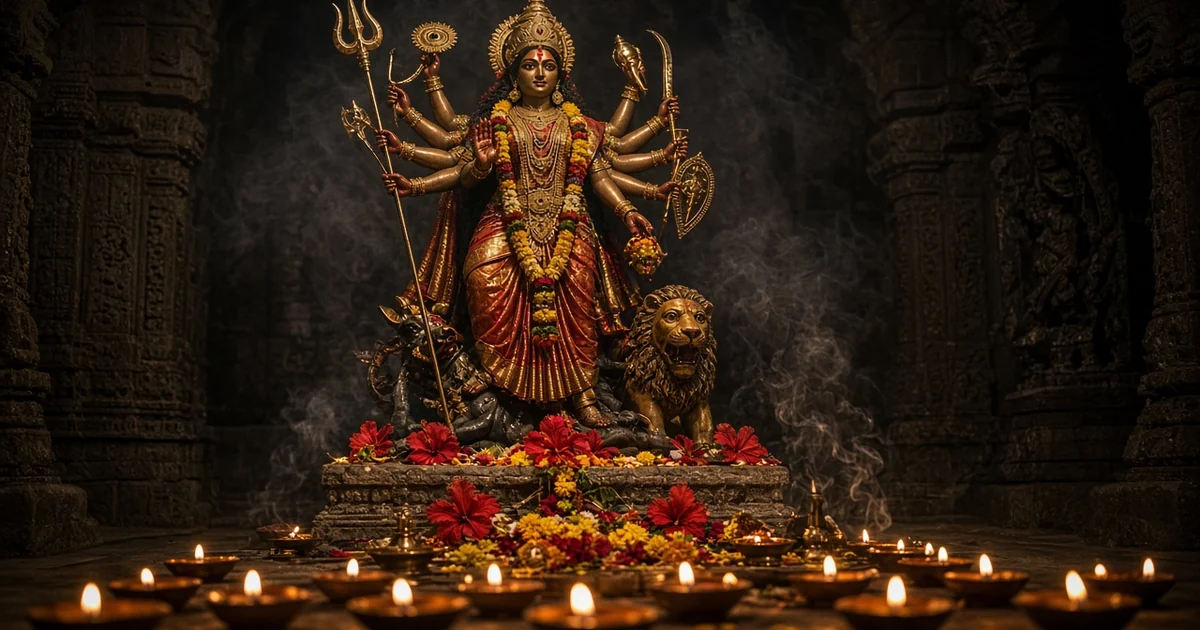
The Mahishasura Mardini Stotram, better known by its opening words Aigiri Nandini, is a 21-verse Sanskrit hymn to Goddess Durga as the slayer of the buffalo-demon Mahishasura. Each verse piles up names and images of the Goddess — her battle, her beauty, her compassion — and ends with the same refrain: jaya jaya he mahiṣāsuramardini ramya-kapardini śailasute, “Victory, victory to you, slayer of Mahishasura, of the beautiful matted locks, daughter of the mountain.”
The hymn is built on the story told in the Durga Saptashati (Devi Mahatmya): Durga’s wars with Madhu and Kaitabha, with Mahisha, with Dhumralochana and Raktabija, and with Shumbha and Nishumbha. Its metre is dense and drum-like, which is why it is so often sung, not merely read. Search interest rises sharply in the weeks before Navratri, but the hymn is kept through the year.
This page gives the widely recited 21-verse Sanskrit, a letter-by-letter transliteration, and an original English meaning of each verse, written from the Sanskrit rather than copied from another translation.
How the hymn is traditionally recited
Choose a quiet time — often a morning in Navratri, a Friday, or the day’s Durga puja. Sit before an image of the Goddess if you have one, light a lamp where it is safe, and recite the 21 verses slowly enough that the refrain can settle. Once the words are familiar, many people sing them to the well-known tune; learning the meaning first keeps the song from becoming only a melody.
A shorter daily practice is to recite the first verse and the refrain, or to sing the hymn along with a clear recording while following the text. The hymn takes about twelve to fifteen minutes at a steady pace, longer when it is sung. Recitation is a spiritual practice, not a substitute for medical, legal or practical help.
For the story behind the battle images, see stories of Goddess Durga and the Durga Saptashati. Other Durga hymns on the site include the Argala Stotram, the Durga Chalisa and a set of powerful Durga mantras.
Who composed it
The hymn is popularly attributed to Adi Shankaracharya. That credit is devotional and long-standing, but it is not a settled historical fact. The 21 verses do not name an author, and the hymn is not found in Shankara’s collected works. A longer 30-verse form, the Bhagavati Padya Pushpanjali Stotram, printed in the Brihat Stotra Ratnakara and in the proofread Sanskrit Documents edition, contains these 21 verses as stanzas 7 to 27 and ends with verses that name the poet Ramakrishna. Gita Press prints a closely related text as Shri Sankata Stuti without naming an author. Neither name can be confirmed, so this page treats the hymn as traditional and of uncertain authorship.
The 21 verses
Verse 1
अयि गिरिनन्दिनि नन्दितमेदिनि विश्वविनोदिनि नन्दनुते गिरिवरविन्ध्यशिरोधिनिवासिनि विष्णुविलासिनि जिष्णुनुते । भगवति हे शितिकण्ठकुटुम्बिनि भूरिकुटुम्बिनि भूरिकृते जय जय हे महिषासुरमर्दिनि रम्यकपर्दिनि शैलसुते ॥१॥
Transliteration: ayi girinandini nanditamedini viśvavinodini nandanute girivaravindhyaśirodhinivāsini viṣṇuvilāsini jiṣṇunute | bhagavati he śitikaṇṭhakuṭumbini bhūrikuṭumbini bhūrikṛte jaya jaya he mahiṣāsuramardini ramyakapardini śailasute ||1||
Meaning: O joyful daughter of the mountain, you who make the earth glad, who delight the whole world, praised with joy; you who dwell on the high ridges of the Vindhya, beloved of Vishnu, praised by the victorious. O Goddess, companion of blue-throated Shiva, mother of a vast family, doer of great deeds — victory, victory to you, slayer of Mahishasura, of beautiful matted locks, daughter of the mountain.
Verse 2
सुरवरवर्षिणि दुर्धरधर्षिणि दुर्मुखमर्षिणि हर्षरते त्रिभुवनपोषिणि शङ्करतोषिणि किल्बिषमोषिणि घोषरते । दनुजनिरोषिणि दितिसुतरोषिणि दुर्मदशोषिणि सिन्धुसुते जय जय हे महिषासुरमर्दिनि रम्यकपर्दिनि शैलसुते ॥२॥
Transliteration: suravaravarṣiṇi durdharadharṣiṇi durmukhamarṣiṇi harṣarate tribhuvanapoṣiṇi śaṅkaratoṣiṇi kilbiṣamoṣiṇi ghoṣarate | danujaniroṣiṇi ditisutaroṣiṇi durmadaśoṣiṇi sindhusute jaya jaya he mahiṣāsuramardini ramyakapardini śailasute ||2||
Meaning: You shower blessings on the foremost of the gods, overpower what cannot be withstood, and put down the evil-faced, delighting in joy; you nourish the three worlds, please Shankara, take away sin, and delight in the sacred cry. You kindle wrath in the sons of Danu and of Diti and dry up their arrogance, O daughter of the ocean — victory, victory to you, slayer of Mahishasura, of beautiful matted locks, daughter of the mountain. (The hymn addresses one Goddess under many names; sindhusute, “daughter of the ocean,” is one of them.)
Verse 3
अयि जगदम्ब मदम्ब कदम्बवनप्रियवासिनि हासरते शिखरिशिरोमणितुङ्गहिमालयशृङ्गनिजालयमध्यगते । मधुमधुरे मधुकैटभगञ्जिनि कैटभभञ्जिनि रासरते जय जय हे महिषासुरमर्दिनि रम्यकपर्दिनि शैलसुते ॥३॥
Transliteration: ayi jagadamba madamba kadambavanapriyavāsini hāsarate śikhariśiromaṇituṅgahimālayaśṛṅganijālayamadhyagate | madhumadhure madhukaiṭabhagañjini kaiṭabhabhañjini rāsarate jaya jaya he mahiṣāsuramardini ramyakapardini śailasute ||3||
Meaning: O Mother of the world, my own mother, you who love to dwell in the kadamba grove and delight in laughter; you whose own home is set among the high snow peaks, the crest-jewels of the mountains. You who are sweet as honey, who crush Madhu and Kaitabha, who delight in play — victory, victory to you, slayer of Mahishasura, of beautiful matted locks, daughter of the mountain.
Verse 4
अयि शतखण्डविखण्डितरुण्डवितुण्डितशुण्डगजाधिपते रिपुगजगण्डविदारणचण्डपराक्रमशुण्ड मृगाधिपते । निजभुजदण्डनिपातितखण्डविपातितमुण्डभटाधिपते जय जय हे महिषासुरमर्दिनि रम्यकपर्दिनि शैलसुते ॥४॥
Transliteration: ayi śatakhaṇḍavikhaṇḍitaruṇḍavituṇḍitaśuṇḍagajādhipate ripugajagaṇḍavidāraṇacaṇḍaparākramaśuṇḍa mṛgādhipate | nijabhujadaṇḍanipātitakhaṇḍavipātitamuṇḍabhaṭādhipate jaya jaya he mahiṣāsuramardini ramyakapardini śailasute ||4||
Meaning: O you who have cut the enemy into a hundred pieces and smashed the trunks of the lord of elephants; O mistress of the lion, whose fierce valour splits the temples of the enemy’s war-elephants. With the staff of your own arm you have struck down and scattered the heads of the captains of the army — victory, victory to you, slayer of Mahishasura, of beautiful matted locks, daughter of the mountain.
Verse 5
अयि रणदुर्मदशत्रुवधोदितदुर्धरनिर्जरशक्तिभृते चतुरविचारधुरीणमहाशिवदूतकृतप्रमथाधिपते । दुरितदुरीहदुराशयदुर्मतिदानवदूतकृतान्तमते जय जय हे महिषासुरमर्दिनि रम्यकपर्दिनि शैलसुते ॥५॥
Transliteration: ayi raṇadurmadaśatruvadhoditadurdharanirjaraśaktibhṛte caturavicāradhurīṇamahāśivadūtakṛtapramathādhipate | duritadurīhadurāśayadurmatidānavadūtakṛtāntamate jaya jaya he mahiṣāsuramardini ramyakapardini śailasute ||5||
Meaning: O you who bear the unassailable, deathless power that rose when you slew the battle-maddened foe; you who made the wise emissary of great Shiva the lord of his host of attendants. You who are death itself to the messengers of the demons — their sins, their crooked will, their evil intent and their dullness of mind — victory, victory to you, slayer of Mahishasura, of beautiful matted locks, daughter of the mountain.
Verse 6
अयि शरणागतवैरिवधूवरवीरवराभयदायकरे त्रिभुवनमस्तकशूलविरोधिशिरोधिकृतामलशूलकरे । दुमिदुमितामरदुन्दुभिनादमहोमुखरीकृततिग्मकरे जय जय हे महिषासुरमर्दिनि रम्यकपर्दिनि शैलसुते ॥६॥
Transliteration: ayi śaraṇāgatavairivadhūvaravīravarābhayadāyakare tribhuvanamastakaśūlavirodhiśirodhikṛtāmalaśūlakare | dumidumitāmaradundubhinādamahomukharīkṛtatigmakare jaya jaya he mahiṣāsuramardini ramyakapardini śailasute ||6||
Meaning: O you who grant safety to noble warriors and to the wives of enemies who have come to you for refuge; you who have set your stainless trident on the heads of those who raised a trident against the three worlds. The gods’ drums sound dumi-dumi until the heavens and even the fierce sun seem to resound — victory, victory to you, slayer of Mahishasura, of beautiful matted locks, daughter of the mountain.
Verse 7
अयि निजहुँकृतिमात्रनिराकृतधूम्रविलोचनधूम्रशते समरविशोषितशोणितबीजसमुद्भवशोणितबीजलते । शिवशिव शुम्भनिशुम्भमहाहवतर्पितभूतपिशाचरते जय जय हे महिषासुरमर्दिनि रम्यकपर्दिनि शैलसुते ॥७॥
Transliteration: ayi nijahuṃkṛtimātranirākṛtadhūmravilocanadhūmraśate samaraviśoṣitaśoṇitabījasamudbhavaśoṇitabījalate | śivaśiva śumbhaniśumbhamahāhavatarpitabhūtapiśācarate jaya jaya he mahiṣāsuramardini ramyakapardini śailasute ||7||
Meaning: O you who, by the mere utterance of your hum, laid waste hundreds of the smoke-eyed host of Dhumralochana; you who, in battle, dried up the blood-seed of Raktabija and the vine of forms that sprang from his blood. O auspicious one, you who offered the great war with Shumbha and Nishumbha as a feast to the spirits who attend on Shiva — victory, victory to you, slayer of Mahishasura, of beautiful matted locks, daughter of the mountain.
Verse 8
धनुरनुषङ्गरणक्षणसङ्गपरिस्फुरदङ्गनटत्कटके कनकपिशङ्गपृषत्कनिषङ्गरसद्भटशृङ्गहतावटुके । कृतचतुरङ्गबलक्षितिरङ्गघटद्बहुरङ्गरटद्बटुके जय जय हे महिषासुरमर्दिनि रम्यकपर्दिनि शैलसुते ॥८॥
Transliteration: dhanuranuṣaṅgaraṇakṣaṇasaṅgaparisphuradaṅganaṭatkaṭake kanakapiśaṅgapṛṣatkaniṣaṅgarasadbhaṭaśṛṅgahatāvaṭuke | kṛtacaturaṅgabalakṣitiraṅgaghaṭadbahuraṅgaraṭadbaṭuke jaya jaya he mahiṣāsuramardini ramyakapardini śailasute ||8||
Meaning: Your body flashes and your anklets dance in the instant the bow is joined to the battle; with a quiver of golden, tawny-spotted arrows you strike down young warriors of the enemy host. You have turned the fourfold army into a stage, ringing with the shouts of many ranks — victory, victory to you, slayer of Mahishasura, of beautiful matted locks, daughter of the mountain.
Verse 9
सुरललनाततथेयितथेयितथाभिनयोत्तरनृत्यरते हासविलासहुलासमयि प्रणतार्तजनेऽमितप्रेमभरे । धिमिकिटधिक्कटधिकटधिमिध्वनिधीरमृदङ्गनिनादरते जय जय हे महिषासुरमर्दिनि रम्यकपर्दिनि शैलसुते ॥९॥
Transliteration: suralalanātatatheyitatheyitathābhinayottaranṛtyarate hāsavilāsahulāsamayi praṇatārtajane’mitapremabhare | dhimikiṭadhikkaṭadhikaṭadhimidhvanidhīramṛdaṅganinādarate jaya jaya he mahiṣāsuramardini ramyakapardini śailasute ||9||
Meaning: You delight in the answering dance of the celestial women, their gestures of tathayi tathayi tatha; you are filled with laughter, play and boundless love for those who bow to you in distress. You delight in the steady dhimi-kita-dhik-kata of the mridanga — victory, victory to you, slayer of Mahishasura, of beautiful matted locks, daughter of the mountain.
Verse 10
जय जय जप्यजये जयशब्दपरस्तुतितत्परविश्वनुते झणझणझिञ्झिमिझङ्कृतनूपुरसिञ्जितमोहितभूतपते । नटितनटार्धनटीनटनायकनाटितनाट्यसुगानरते जय जय हे महिषासुरमर्दिनि रम्यकपर्दिनि शैलसुते ॥१०॥
Transliteration: jaya jaya japyajaye jayaśabdaparastutitatparaviśvanute jhaṇajhaṇajhiñjhimijhaṅkṛtanūpurasiñjitamohitabhūtapate | naṭitanaṭārdhanaṭīnaṭanāyakanāṭitanāṭyasugānarate jaya jaya he mahiṣāsuramardini ramyakapardini śailasute ||10||
Meaning: Victory, victory — you who are to be won by the japa of victory, whom the whole world praises with the word jaya. The jhana-jhana and jhinjimi of your anklets charm even the lord of beings. You delight in the enacted dance of the half-dance, the dance-master and the accompanying song — victory, victory to you, slayer of Mahishasura, of beautiful matted locks, daughter of the mountain.
Verse 11
अयि सुमनःसुमनः सुमनः सुमनः सुमनोहरकान्तियुते श्रितरजनीरजनीरजनीरजनीरजनीकरवक्त्रवृते । सुनयनविभ्रमरभ्रमरभ्रमरभ्रमरभ्रमराधिपते जय जय हे महिषासुरमर्दिनि रम्यकपर्दिनि शैलसुते ॥११॥
Transliteration: ayi sumanaḥsumanaḥ sumanaḥ sumanaḥ sumanoharakāntiyute śritarajanīrajanīrajanīrajanīrajanīkaravaktravṛte | sunayanavibhramarabhramarabhramarabhramarabhramarādhipate jaya jaya he mahiṣāsuramardini ramyakapardini śailasute ||11||
Meaning: O you who are joined to a beauty that steals the mind, named again and again with the word sumanah — flower, and also a good heart. You are surrounded by faces that are like the night-maker, the moon; you are the chief of the bees that hover, wander and circle at your lovely eyes — victory, victory to you, slayer of Mahishasura, of beautiful matted locks, daughter of the mountain. (This verse is largely sound-play: the same words are repeated so that the hymn itself becomes a kind of drum.)
Verse 12
सहितमहाहवमल्लमतल्लिकमल्लितरल्लकमल्लरते विरचितवल्लिकपल्लिकमल्लिकझिल्लिकभिल्लिकवर्गवृते । सितकृतफुल्लसमुल्लसितारुणतल्लजपल्लवसल्ललिते जय जय हे महिषासुरमर्दिनि रम्यकपर्दिनि शैलसुते ॥१२॥
Transliteration: sahitamahāhavamallamatallikamallitarallakamallarate viracitavallikapallikamallikajhillikabhillikavargavṛte | sitakṛtaphullasamullasitāruṇatallajapallavasallalite jaya jaya he mahiṣāsuramardini ramyakapardini śailasute ||12||
Meaning: You delight in the champion-wrestlers of the great battle, in their sport and their flowing garments; you are surrounded by the tribes of the hills and the woods, by creepers, blossoms, crickets and the people of the forest. You are graceful as a fresh red leaf that has burst into bloom, shining and pale-tinged — victory, victory to you, slayer of Mahishasura, of beautiful matted locks, daughter of the mountain.
Verse 13
अविरलगण्डगलन्मदमेदुरमत्तमतङ्गजराजपते त्रिभुवनभूषणभूतकलानिधिरूपपयोनिधिराजसुते । अयि सुदतीजनलालसमानसमोहनमन्मथराजसुते जय जय हे महिषासुरमर्दिनि रम्यकपर्दिनि शैलसुते ॥१३॥
Transliteration: aviralagaṇḍagalanmadameduramattamataṅgajarājapate tribhuvanabhūṣaṇabhūtakalānidhirūpapayonidhirājasute | ayi sudatījanalālasamānasamohanamanmatharājasute jaya jaya he mahiṣāsuramardini ramyakapardini śailasute ||13||
Meaning: O mistress of the king of elephants, whose cheeks stream without pause with rut-ichor; O daughter of the ocean, you who have the form of the treasure of the arts, the ornament of the three worlds. O daughter of the king of love, you who charm and fill with longing the women of beautiful teeth — victory, victory to you, slayer of Mahishasura, of beautiful matted locks, daughter of the mountain.
Verse 14
कमलदलामलकोमलकान्तिकलाकलितामलभाललते सकलविलासकलानिलयक्रमकेलिचलत्कलहंसकुले । अलिकुलसङ्कुलकुवलयमण्डलमौलिमिलद्बकुलालिकुले जय जय हे महिषासुरमर्दिनि रम्यकपर्दिनि शैलसुते ॥१४॥
Transliteration: kamaladalāmalakomalakāntikalākalitāmalabhālalate sakalavilāsakalānilayakramakelicalatkalahaṃsakule | alikulasaṅkulakuvalayamaṇḍalamaulimiladbakulālikule jaya jaya he mahiṣāsuramardini ramyakapardini śailasute ||14||
Meaning: Your stainless forehead is a tender vine of light, soft and pure as a lotus petal. You are the home of every graceful art, and a flock of soft-paced swans moves in your play. A swarm of bees joins the circle of water-lilies, meeting the bakula-blossoms at your crown — victory, victory to you, slayer of Mahishasura, of beautiful matted locks, daughter of the mountain.
Verse 15
करमुरलीरववीजितकूजितलज्जितकोकिलमञ्जुमते मिलितमिलिन्दमनोहरगुञ्जितरञ्जितशैलनिकुञ्जगते । निजगुणभूतमहाशबरीगणसद्गुणसम्भृतकेलितले जय जय हे महिषासुरमर्दिनि रम्यकपर्दिनि शैलसुते ॥१५॥
Transliteration: karamuralīravavījitakūjitalajjitakokilamañjumate militamilindamanoharaguñjitarañjitaśailanikuñjagate | nijaguṇabhūtamahāśabarīgaṇasadguṇasambhṛtakelitale jaya jaya he mahiṣāsuramardini ramyakapardini śailasute ||15||
Meaning: The flute in your hand sends a sound that puts even the calling cuckoo to shame, so sweet is your mind. You move in the mountain groves that are coloured and made lovely by the humming of gathered bees. On ground made for play, filled with the good qualities of your own attendants, the great host of Shabari women — victory, victory to you, slayer of Mahishasura, of beautiful matted locks, daughter of the mountain.
Verse 16
कटितटपीतदुकूलविचित्रमयूखतिरस्कृतचन्द्ररुचे प्रणतसुरासुरमौलिमणिस्फुरदंशुलसन्नखचन्द्ररुचे । जितकनकाचलमौलिपदोर्जितनिर्जरकुञ्जरकुम्भकुचे जय जय हे महिषासुरमर्दिनि रम्यकपर्दिनि शैलसुते ॥१६॥
Transliteration: kaṭitaṭapītadukūlavicitramayūkhatiraskṛtacandraruce praṇatasurāsuramaulimaṇisphuradaṃśulasannakhacandraruce | jitakanakācalamaulipadorjitanirjarakuñjarakumbhakuce jaya jaya he mahiṣāsuramardini ramyakapardini śailasute ||16||
Meaning: The many-coloured rays of the yellow silk at your waist put the light of the moon to shame; the moon-bright nails of your feet flash with the light of the crest-jewels of gods and demons who bow before you. Your bosom, like the temples of a divine elephant, outshines the peak of the golden mountain — victory, victory to you, slayer of Mahishasura, of beautiful matted locks, daughter of the mountain.
Verse 17
विजितसहस्रकरैकसहस्रकरैकसहस्रकरैकनुते कृतसुरतारकसङ्गरतारकसङ्गरतारकसूनुसुते । सुरथसमाधिसमानसमाधिसमाधिसमाधिसुजातरते जय जय हे महिषासुरमर्दिनि रम्यकपर्दिनि शैलसुते ॥१७॥
Transliteration: vijitasahasrakaraikasahasrakaraikasahasrakaraikanute kṛtasuratārakasaṅgaratārakasaṅgaratārakasūnusute | surathasamādhisamānasamādhisamādhisamādhisujātarate jaya jaya he mahiṣāsuramardini ramyakapardini śailasute ||17||
Meaning: You are praised as the one who has surpassed a thousand-rayed sun, as one thousand-rayed, as uniquely thousand-rayed. You are the mother of the son who fought the war of the gods with Taraka (Kartikeya). You delight in the well-born, even absorption that is like the samadhi of King Suratha — victory, victory to you, slayer of Mahishasura, of beautiful matted locks, daughter of the mountain.
Verse 18
पदकमलं करुणानिलये वरिवस्यति योऽनुदिनं सुशिवे अयि कमले कमलानिलये कमलानिलयः स कथं न भवेत् । तव पदमेव परम्पदमेवनुशीलयतो मम किं न शिवे जय जय हे महिषासुरमर्दिनि रम्यकपर्दिनि शैलसुते ॥१८॥
Transliteration: padakamalaṃ karuṇānilaye varivasyati yo’nudinaṃ suśive ayi kamale kamalānilaye kamalānilayaḥ sa kathaṃ na bhavet | tava padameva parampadamevanuśīlayato mama kiṃ na śive jaya jaya he mahiṣāsuramardini ramyakapardini śailasute ||18||
Meaning: Whoever serves your lotus feet every day, O compassionate one, O truly auspicious one — O lotus-goddess, abode of the lotus — how would that person not become an abode of fortune? For one who cultivates your feet as the supreme goal, O auspicious Goddess, what would be lacking for me? — victory, victory to you, slayer of Mahishasura, of beautiful matted locks, daughter of the mountain.
Verse 19
कनकलसत्कलसिन्धुजलैरनुसिञ्चिनुते गुण रङ्गभुवं भजति स किं न शचीकुचकुम्भतटीपरिरम्भसुखानुभवम् । तव चरणं शरणं करवाणि नतामरवाणिनिवासि शिवं जय जय हे महिषासुरमर्दिनि रम्यकपर्दिनि शैलसुते ॥१९॥
Transliteration: kanakalasatkalasindhujalairanusiñcinute guṇa raṅgabhuvaṃ bhajati sa kiṃ na śacīkucakumbhataṭīparirambhasukhānubhavam | tava caraṇaṃ śaraṇaṃ karavāṇi natāmaravāṇinivāsi śivaṃ jaya jaya he mahiṣāsuramardini ramyakapardini śailasute ||19||
Meaning: Would the one who sprinkles the stage of your qualities with the shining golden waters of the ocean not also come to the joy of a divine embrace? I take refuge at your feet; O you in whom the speech of the bowed gods dwells, grant me well-being — victory, victory to you, slayer of Mahishasura, of beautiful matted locks, daughter of the mountain.
Verse 20
तव विमलेन्दुकुलं वदनेन्दुमलं सकलं ननु कूलयते किमु पुरुहूतपुरीन्दुमुखीसुमुखीभिरसौ विमुखीक्रियते । मम तु मतं शिवनामधने भवतीकृपया किमुत क्रियते जय जय हे महिषासुरमर्दिनि रम्यकपर्दिनि शैलसुते ॥२०॥
Transliteration: tava vimalendukulaṃ vadanendumalaṃ sakalaṃ nanu kūlayate kimu puruhūtapurīndumukhīsumukhībhirasau vimukhīkriyate | mama tu mataṃ śivanāmadhane bhavatīkṛpayā kimuta kriyate jaya jaya he mahiṣāsuramardini ramyakapardini śailasute ||20||
Meaning: Does not the stainless moon-circle of your face make every other moonlight reach its shore — and would the moon-faced women of Indra’s city not turn away their faces before it? Yet my own wish, O you whose treasure is the name of Shiva, is only what your compassion will do — victory, victory to you, slayer of Mahishasura, of beautiful matted locks, daughter of the mountain.
Verse 21
अयि मयि दीनदयालुतया कृपयैव त्वया भवितव्यमुमे अयि जगतो जननी कृपयासि यथासि तथाऽनुमितासि रते । यदुचितमत्र भवत्युररीकुरुतादुरुतापमपाकुरुते जय जय हे महिषासुरमर्दिनि रम्यकपर्दिनि शैलसुते ॥२१॥
Transliteration: ayi mayi dīnadayālutayā kṛpayaiva tvayā bhavitavyamume ayi jagato jananī kṛpayāsi yathāsi tathā’numitāsi rate | yaducitamatra bhavatyurarīkurutādurutāpamapākurute jaya jaya he mahiṣāsuramardini ramyakapardini śailasute ||21||
Meaning: O Uma, you must look on me with compassion, for you are tender toward the poor. O Mother of the world, you are as gracious as you are, and you are known by that grace, O beloved. Do, O Goddess, whatever is right here, and take away this great suffering — victory, victory to you, slayer of Mahishasura, of beautiful matted locks, daughter of the mountain.
Text notes
The Sanskrit above follows the widely recited 21-verse recension, checked against the proofread Sanskrit Documents edition of the Bhagavati Padya Pushpanjali Stotram (transliterated by A. Hudli and G. Ramkumar; proofread by Sunder Hattangadi and Rajani Arjun Shankar). That edition prints a longer 30-verse text; the common Mahishasura Mardini Stotram is verses 7–27 of that text, numbered 1–21 above. Printed copies differ in a few words:
- Verse 1: many singers use nandinute in place of nandanute.
- Verse 4: some editions read kramaśauṇḍa and nipātitacaṇḍa in place of śuṇḍa and khaṇḍa.
- Verse 6: the drum-line has several small spoken variants.
- Verse 15: some editions read nija-gaṇa-bhūta-mahā-śabarī-gaṇa-raṅgaṇa-sambhṛta-keli-rate in the last quarter.
- Verse 19: some editions end the petition with mṛḍāni sadā mayi dehi śivam.
If you are learning the hymn by heart, stay with one printed edition or a teacher so the small differences do not unsettle the recitation.
The English meanings on this page are original to VedicVani. They aim to say plainly what the Sanskrit names, not to replace a word-for-word scholarly commentary. A few verses (especially 9–12) are written as much for sound as for sense; the meaning there is a guide, not a full account of every echo.
Related reading
For the narrative behind the hymn, see stories of Goddess Durga and the meaning of the Durga Saptashati. Other recitations include the Argala Stotram, the Durga Chalisa and powerful Durga mantras. The nine forms worshipped in Navratri are described in the nine forms of Durga.
Frequently Asked Questions
Is Aigiri Nandini the same as the Mahishasura Mardini Stotram?
Yes. Aigiri Nandini is the popular name for the same hymn, taken from its opening words ayi giri-nandini, 'O joyful daughter of the mountain.' Both names refer to the widely recited 21-verse Sanskrit stotra to Durga.
How many verses are in the Mahishasura Mardini Stotram?
The version most people sing has 21 verses, each ending with the refrain jaya jaya he mahishasuramardini ramya-kapardini shailasute. A longer 30-verse form, the Bhagavati Padya Pushpanjali Stotram, includes these 21 verses (as verses 7 to 27) with extra opening and closing stanzas.
Who wrote Aigiri Nandini?
The author is uncertain. The hymn is popularly attributed to Adi Shankaracharya, but it is not found in his collected works, and the verses themselves do not name a poet. A longer printed form, the Bhagavati Padya Pushpanjali Stotram, ends with stanzas that name the poet Ramakrishna. Neither attribution can be proved. It is best described as a traditional hymn of uncertain authorship.
When should I recite Aigiri Nandini?
It is widely recited through Navratri, and in Bengal it is part of the Mahalaya dawn broadcast that opens Durga Puja. Many households also sing it on Fridays, on Ashtami, or as a daily hymn to Durga. Recite it slowly enough at first that the refrain can settle; the familiar tune can come later.
What does the refrain of the Mahishasura Mardini Stotram mean?
Each verse ends with jaya jaya he mahishasuramardini ramya-kapardini shailasute: 'Victory, victory to you, slayer of Mahishasura, of the beautiful matted locks, daughter of the mountain.'
Are there different versions of the text?
Yes. Printed editions differ in a few words, and some copies add opening or closing verses around the familiar 21. If you are learning the hymn by heart, stay with one printed edition or a teacher so the small differences do not unsettle the recitation.