
🕉️ Practice Guides
Shiva Tandava Stotram: Sanskrit Lyrics, Transliteration and Meaning
The Shiva Tandava Stotram is a Sanskrit hymn traditionally attributed to Ravana, in praise of Shiva's fierce dance. Here is the widely recited 17-verse recension, a clear transliteration and an original English meaning of each verse.
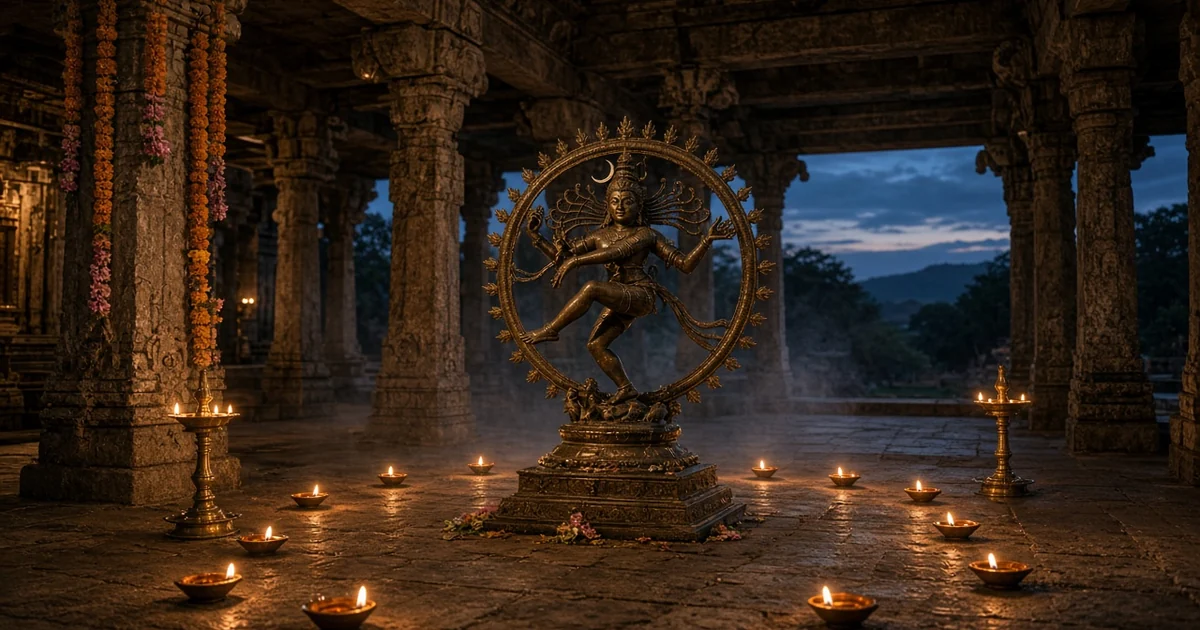
The Shiva Tandava Stotram is a Sanskrit hymn in praise of Shiva’s fierce dance, traditionally attributed to Ravana. It is known for a driving metre, dense alliteration, and images of the Ganga in the matted hair, the damaru, the brow-fire and the moon. The recension on this page has seventeen verses.
A shorter overview, without the full Sanskrit, is on Shiv Tandav Stotram meaning. For Shiva practice more broadly, see Om Namah Shivaya and powerful Shiva mantras.
How the hymn is shaped
Verses 1–16 are in panchachamara: sixteen syllables in each line, laghu and guru alternating. Verse 17, the phalashruti, is in a different metre, vasantatilaka. The English meanings on this page are original to VedicVani. They aim to say plainly what the Sanskrit names, not to replace a word-for-word commentary, and not to imitate a recorded song.
Some booklets print fifteen to nineteen verses. The text below follows the extended 17-verse recension on Sanskrit Documents and notes the main variants, including two extra verses found in some versions.
How to recite
- Sit before a Shiva shrine, at pradosh if you can, or in the morning. A lamp is enough.
- Recite slowly. The hymn is built on a drum-like rhythm; rushing it blurs the consonants that carry the sense.
- Stay with one printed edition while you learn it. Small variants (noted below) are common.
- Recitation is a spiritual practice, not a performance and not a substitute for ordinary care.
The 17 verses
Verse 1
जटाटवीगलज्जलप्रवाहपावितस्थले गलेऽवलम्ब्य लम्बितां भुजङ्गतुङ्गमालिकाम् । डमड्डमड्डमड्डमन्निनादवड्डमर्वयं चकार चण्डताण्डवं तनोतु नः शिवः शिवम् ॥1॥
Transliteration: jaṭāṭavīgalajjalapravāhapāvitasthale gale’valambya lambitāṃ bhujaṅgatuṅgamālikām | ḍamaḍḍamaḍḍamaḍḍamanninādavaḍḍamarvayaṃ cakāra caṇḍatāṇḍavaṃ tanotu naḥ śivaḥ śivam ||1||
Meaning: May Shiva, who performed the fierce Tandava, grant us well-being — Shiva, whose throat is made holy by the forest-stream of the Ganga falling from his matted hair, who wears a lofty garland of a hanging snake, and whose damaru sounds damat-damat-damat-damat.
Verse 2
जटाकटाहसम्भ्रमभ्रमन्निलिम्पनिर्झरीविलोलवीचिवल्लरीविराजमानमूर्द्धनि । धगद्धगद्धगज्ज्वलल्ललाटपट्टपावके किशोरचन्द्रशेखरे रतिः प्रतिक्षणं मम ॥2॥
Transliteration: jaṭākaṭāhasambhramabhramannilimpanirjharīvilolavīcivallarīvirājamānamūrddhani | dhagaddhagaddhagajjvalallalāṭapaṭṭapāvake kiśoracandraśekhare ratiḥ pratikṣaṇaṃ mama ||2||
Meaning: My love, at every moment, is for him who wears the young moon as a crest: the celestial river tosses in the hollow of his matted hair, and its restless waves crown his head, while the fire on the broad of his forehead burns with a sound of dhagat-dhagat-dhagat.
Verse 3
धराधरेन्द्रनन्दिनीविलासबन्धुबन्धुरस्फुरद्दिगन्तसन्ततिप्रमोदमानमानसे । कृपाकटाक्षधोरणीनिरुद्धदुर्धरापदि क्वचिद्दिगम्बरे मनो विनोदमेतु वस्तुनि ॥3॥
Transliteration: dharādharendranandinīvilāsabandhubandhurasphuraddigantasantatipramodamānamānase | kṛpākaṭākṣadhoraṇīniruddhadurdharāpadi kvaciddigambare mano vinodametu vastuni ||3||
Meaning: May my mind find its delight in that One who, somewhere, is sky-clad — whose heart is glad at the joy that flashes to the ends of the quarters, a joy close to his sport with the daughter of the mountain, and whose stream of gracious glances holds back misfortunes that cannot otherwise be borne. Some editions read cidambare, ‘in consciousness,’ in place of digambare.
Verse 4
जटाभुजङ्गपिङ्गलस्फुरत्फणामणिप्रभाकदम्बकुङ्कुमद्रवप्रलिप्तदिग्वधूमुखे । मदान्धसिन्धुरस्फुरत्त्वगुत्तरीयमेदुरे मनो विनोदमद्भुतं बिभर्तु भूतभर्तरि ॥4॥
Transliteration: jaṭābhujaṅgapiṅgalasphuratphaṇāmaṇiprabhākadambakuṅkumadravapraliptadigvadhūmukhe | madāndhasindhurasphurattvaguttarīyamedure mano vinodamadbhutaṃ bibhartu bhūtabhartari ||4||
Meaning: May my mind bear a wonder of delight in the supporter of all beings: the tawny light of the jewels in the snake-hoods of his matted hair is like a thick paste of saffron smeared on the faces of the women of the directions, and he is wrapped in the shivering hide of a rut-maddened elephant.
Verse 5
सहस्रलोचनप्रभृत्यशेषलेखशेखरप्रसूनधूलिधोरणीविधूसराङ्घ्रिपीठभूः । भुजङ्गराजमालया निबद्धजाटजूटकः श्रियै चिराय जायतां चकोरबन्धुशेखरः ॥5॥
Transliteration: sahasralocanaprabhṛtyaśeṣalekhaśekharaprasūnadhūlidhoraṇīvidhūsarāṅghripīṭhabhūḥ | bhujaṅgarājamālayā nibaddhajāṭajūṭakaḥ śriyai cirāya jāyatāṃ cakorabandhuśekharaḥ ||5||
Meaning: May he whose crest is the friend of the chakora — the moon — long grant us prosperity: his footstool is grey with the pollen-dust of flowers from the crowns of Indra and all the gods, and his matted locks are bound with a garland of the king of snakes.
Verse 6
ललाटचत्वरज्वलद्धनञ्जयस्फुलिङ्गभानिपीतपञ्चसायकं नमन्निलिम्पनायकम् । सुधामयूखलेखया विराजमानशेखरं महाकपालि सम्पदे शिरो जटालमस्तु नः ॥6॥
Transliteration: lalāṭacatvarajvaladdhanañjayasphuliṅgabhānipītapañcasāyakaṃ namannilimpanāyakam | sudhāmayūkhalekhayā virājamānaśekharaṃ mahākapāli sampade śiro jaṭālamastu naḥ ||6||
Meaning: May that skull-bearing, matted head be for our well-being: the sparks of the fire blazing on the courtyard of his forehead have swallowed the five arrows of Kama; the lord of the gods bows before him; and his crest shines with a digit of the nectar-rayed moon.
Verse 7
करालभालपट्टिकाधगद्धगद्धगज्ज्वलद्धनञ्जयाहुतीकृतप्रचण्डपञ्चसायके । धराधरेन्द्रनन्दिनीकुचाग्रचित्रपत्रकप्रकल्पनैकशिल्पिनि त्रिलोचने रतिर्मम ॥7॥
Transliteration: karālabhālapaṭṭikādhagaddhagaddhagajjvaladdhanañjayāhutīkṛtapracaṇḍapañcasāyake | dharādharendranandinīkucāgracitrapatrakaprakalpanaikaśilpini trilocane ratirmama ||7||
Meaning: My love is for the three-eyed one, the sole artist who paints the adornment on the bosom of the mountain’s daughter, and who made a fierce offering of Kama’s five arrows in the fire that blazes dhagat-dhagat-dhagat on the dreadful plate of his brow.
Verse 8
नवीनमेघमण्डलीनिरुद्धदुर्धरस्फुरत्कुहूनिशीथिनीतमःप्रबन्धबद्धकन्धरः । निलिम्पनिर्झरीधरस्तनोतु कृत्तिसिन्धुरः कलानिधानबन्धुरः श्रियं जगद्धुरन्धरः ॥8॥
Transliteration: navīnameghamaṇḍalīniruddhadurdharasphuratkuhūniśīthinītamaḥprabandhabaddhakandharaḥ | nilimpanirjharīdharastanotu kṛttisindhuraḥ kalānidhānabandhuraḥ śriyaṃ jagaddhurandharaḥ ||8||
Meaning: May he grant us prosperity — he who bears the celestial river, who is lovely with the store of the arts, who carries the world: his neck is as dark as a new-moon night bound in a bank of fresh clouds, and he is clothed in an elephant’s hide.
Verse 9
प्रफुल्लनीलपङ्कजप्रपञ्चकालिमप्रभाऽवलम्बिकण्ठकन्दलीरुचिप्रबद्धकन्धरम् । स्मरच्छिदं पुरच्छिदं भवच्छिदं मखच्छिदं गजच्छिदान्धकच्छिदं तमन्तकच्छिदं भजे ॥9॥
Transliteration: praphullanīlapaṅkajaprapañcakālimaprabhā’valambikaṇṭhakandalīruciprabaddhakandharam | smaracchidaṃ puracchidaṃ bhavacchidaṃ makhacchidaṃ gajacchidāndhakacchidaṃ tamantakacchidaṃ bhaje ||9||
Meaning: I worship him who cut down Kama, who cut down the Triple City, who cuts the wandering of birth, who cut down the sacrifice, who cut down the elephant, who cut down Andhaka, who cuts down Death: his neck is darkened by the beauty of a shining cluster of full-blown blue lotuses hanging there.
Verse 10
अखर्वसर्वमङ्गलाकलाकदम्बमञ्जरीरसप्रवाहमाधुरीविजृम्भणामधुव्रतम् । स्मरान्तकं पुरान्तकं भवान्तकं मखान्तकं गजान्तकान्धकान्तकं तमन्तकान्तकं भजे ॥10॥
Transliteration: akharvasarvamaṅgalākalākadambamañjarīrasapravāhamādhurīvijṛmbhaṇāmadhuvratam | smarāntakaṃ purāntakaṃ bhavāntakaṃ makhāntakaṃ gajāntakāndhakāntakaṃ tamantakāntakaṃ bhaje ||10||
Meaning: I worship him who made an end of Kama, of the Triple City, of becoming, of the sacrifice, of the elephant, of Andhaka, and of Death: he is the bee that opens in the sweetness flowing from the blossom-cluster of all true auspicious arts.
Verse 11
जयत्वदभ्रविभ्रमभ्रमद्भुजङ्गमश्वसद्विनिर्गमत्क्रमस्फुरत्करालभालहव्यवाट् । धिमिद्धिमिद्धिमिद्ध्वनन्मृदङ्गतुङ्गमङ्गलध्वनिक्रमप्रवर्तितप्रचण्डताण्डवः शिवः ॥11॥
Transliteration: jayatvadabhravibhramabhramadbhujaṅgamaśvasadvinirgamatkramasphuratkarālabhālahavyavāṭ | dhimiddhimiddhimiddhvananmṛdaṅgatuṅgamaṅgaladhvanikramapravartitapracaṇḍatāṇḍavaḥ śivaḥ ||11||
Meaning: May Shiva be victorious, whose fierce Tandava is set in motion by the high, auspicious sequence of a mridanga sounding dhimid-dhimid-dhimid, and whose dreadful brow-fire flares as the breath of the whirling snake goes out.
Verse 12
दृषद्विचित्रतल्पयोर्भुजङ्गमौक्तिकस्रजोर्गरिष्ठरत्नलोष्ठयोः सुहृद्विपक्षपक्षयोः । तृणारविन्दचक्षुषोः प्रजामहीमहेन्द्रयोः समप्रवृत्तिकः कदा सदाशिवं भजाम्यहम् ॥12॥
Transliteration: dṛṣadvicitratalpayorbhujaṅgamauktikasrajorgariṣṭharatnaloṣṭhayoḥ suhṛdvipakṣapakṣayoḥ | tṛṇāravindacakṣuṣoḥ prajāmahīmahendrayoḥ samapravṛttikaḥ kadā sadāśivaṃ bhajāmyaham ||12||
Meaning: When shall I worship Sadashiva with an even mind — toward a stone couch and a wondrous one, toward a snake and a pearl garland, toward a heavy gem and a clod of earth, toward a friend and an opponent, toward a blade of grass and a lotus-like eye, toward the people and the great Indra of the earth?
Verse 13
कदा निलिम्पनिर्झरीनिकुञ्जकोटरे वसन् विमुक्तदुर्मतिः सदा शिरःस्थमञ्जलिं वहन् । विलोललोललोचनो ललामभाललग्नकः शिवेति मन्त्रमुच्चरन् कदा सुखी भवाम्यहम् ॥13॥
Transliteration: kadā nilimpanirjharīnikuñjakoṭare vasan vimuktadurmatiḥ sadā śiraḥsthamañjaliṃ vahan | vilolalolalocano lalāmabhālalagnakaḥ śiveti mantramuccaran kadā sukhī bhavāmyaham ||13||
Meaning: When shall I be at peace, living in a hollow of the thicket by the celestial river, free of a crooked mind, always carrying folded hands above my head, my restless eyes fixed on the mark of his forehead, uttering the mantra ‘Shiva’?
Verse 14
निलिम्पनाथनागरीकदम्बमौलमल्लिकानिगुम्फनिर्भरक्षरन्मधूष्णिकामनोहरः । तनोतु नो मनोमुदं विनोदिनीमहर्निशं परश्रियः परं पदं तदङ्गजत्विषां चयः ॥14॥
Transliteration: nilimpanāthanāgarīkadambamaulamallikānigumphanirbharakṣaranmadhūṣṇikāmanoharaḥ | tanotu no manomudaṃ vinodinīmaharniśaṃ paraśriyaḥ paraṃ padaṃ tadaṅgajatviṣāṃ cayaḥ ||14||
Meaning: May the gather of that splendour — more than the highest Lakshmi, the supreme state — always give delight to our minds: it is the enchanting fragrance of honey dripping from a thick garland of mallika blossoms on the locks of the goddess who is lady of the lord of the immortals.
Verse 15
प्रचण्डवाडवानलप्रभाशुभप्रचारणी महाष्टसिद्धिकामिनीजनाऽवहूतजल्पना । विमुक्तवामलोचनाविवाहकालिकध्वनिः शिवेति मन्त्रभूषणा जगज्जयाय जायताम् ॥15॥
Transliteration: pracaṇḍavāḍavānalaprabhāśubhapracāraṇī mahāṣṭasiddhikāminījanā’vahūtajalpanā | vimuktavāmalocanāvivāhakālikadhvaniḥ śiveti mantrabhūṣaṇā jagajjayāya jāyatām ||15||
Meaning: May she whose ornament is the mantra ‘Shiva’ prevail for the winning of the world: her auspicious radiance is like a fierce submarine fire; she silences the talk of those who long for the eight great siddhis; and her sound is the wedding music of her whose left eye is liberated in love. The verse is traditionally read as a blessing spoken of Parvati, or of the mantra itself.
Verse 16
इमं हि नित्यमेवमुक्तमुत्तमोत्तमं स्तवं पठन्स्मरन्ब्रुवन्नरो विशुद्धिमेतिसन्ततम् । हरे गुरौ सुभक्तिमाशु याति नाऽन्यथा गतिं विमोहनं हि देहिनां सुशङ्करस्य चिन्तनम् ॥16॥
Transliteration: imaṃ hi nityamevamuktamuttamottamaṃ stavaṃ paṭhansmaranbruvannaro viśuddhimetisantatam | hare gurau subhaktimāśu yāti nā’nyathā gatiṃ vimohanaṃ hi dehināṃ suśaṅkarasya cintanam ||16||
Meaning: A person who always recites, remembers and speaks this most excellent hymn is purified without a break, and quickly comes to true devotion toward Hari and the Guru; there is no other way. For embodied beings, the thought of Shankara itself undoes delusion.
Verse 17
पूजावसानसमये दशवक्त्रगीतं यः शम्भुपूजनपरं पठति प्रदोषे । तस्य स्थिरां रथगजेन्द्रतुरङ्गयुक्तां लक्ष्मीं सदैव सुमुखीं प्रददाति शम्भुः ॥17॥
Transliteration: pūjāvasānasamaye daśavaktragītaṃ yaḥ śambhupūjanaparaṃ paṭhati pradoṣe | tasya sthirāṃ rathagajendraturaṅgayuktāṃ lakṣmīṃ sadaiva sumukhīṃ pradadāti śambhuḥ ||17||
Meaning: Whoever, intent on the worship of Shambhu, recites at pradosh, at the close of the puja, this song of the ten-headed one — to that person Shambhu always gives a gracious, steady Lakshmi, attended by chariots, elephants and horses.
Text notes
The Sanskrit above follows the 17-verse recension traditionally attributed to Ravana, checked against the proofread Sanskrit Documents edition (transliterated and proofread by Girish Beeharry and Sushil D. Sharma, with later proofreading; the file notes a latest update of 27 May 2026). That edition itself records variants in parentheses and states that some versions carry 15–19 verses. Points worth knowing:
- Verse 3: some prints read cidambare (“in consciousness”) in place of digambare (“sky-clad”).
- Verse 5: śriyai and śriye both occur.
- Verse 10: some prints read agarva in place of akharva.
- Verse 12: some editions begin spṛṣad-vicitra- rather than dṛṣad-vicitra-.
- Verse 17: a shorter ending, lakṣmīṃ prasādasamaye pradadāti śambhuḥ, is also found.
- Two additional verses appear in some booklets after the phalashruti, beginning namāmi pārvatīpatiṃ and rāvaṇena kṛtaṃ stotram. They are not included in the recension above.
If you are learning the hymn by heart, stay with one printed edition or a teacher. The English meanings on this page are original to VedicVani. This is the traditional Sanskrit stotra, not a modern recorded lyric.
Related reading
A shorter overview is on Shiv Tandav Stotram meaning. For Shiva practice, see Om Namah Shivaya, powerful Shiva mantras, the Lingashtakam, the Shiva Panchakshara Stotram, the Dakshinamurthy Stotram, and stories of Lord Shiva. Maha Shivratri is on 6 March 2027.
Frequently Asked Questions
Who wrote the Shiva Tandava Stotram?
The hymn is traditionally attributed to Ravana, the ten-headed king of Lanka, as a song of Shiva's Tandava. The attribution is traditional rather than a modern historical proof. The Sanskrit on this page follows the 17-verse recension proofread on Sanskrit Documents.
How many verses are in the Shiva Tandava Stotram?
The recension used here has seventeen verses. Some printed versions have fifteen, sixteen or as many as nineteen; two extra verses found in some booklets are noted at the end but not treated as part of this core text. Verses 1–16 are in the panchachamara metre; verse 17 is in vasantatilaka.
Is this the same as the Shiva Tandava 'song lyrics' people search for?
The Sanskrit stotra is a public-domain hymn. Modern recorded songs, film versions and copyrighted translations are not this text, and they are not reproduced here. If you are learning the hymn, stay with a printed Sanskrit edition or a teacher.
How should I recite the Shiva Tandava Stotram?
Sit cleanly before a Shiva shrine, ideally at pradosh or in the early morning. Recite slowly enough to hear the laghu-guru rhythm. Verse 17 itself recommends recitation at the close of puja, at pradosh, by one intent on the worship of Shambhu. Recitation is a spiritual practice, not a substitute for ordinary care.
Is there already a meaning page on this site?
Yes. A shorter overview is on the [Shiv Tandav Stotram meaning](/blog/shiv-tandav-stotram-meaning/) page. This page gives the full Sanskrit, a transliteration and a verse-by-verse meaning.