
🔱 Practice Guides
Shiva Panchakshara Stotram: Lyrics, Meaning and Five Verses
The Shiva Panchakshara Stotram praises each syllable of Namah Shivaya in turn. Here is the Sanskrit, a clear transliteration, and an original English meaning of the five verses.
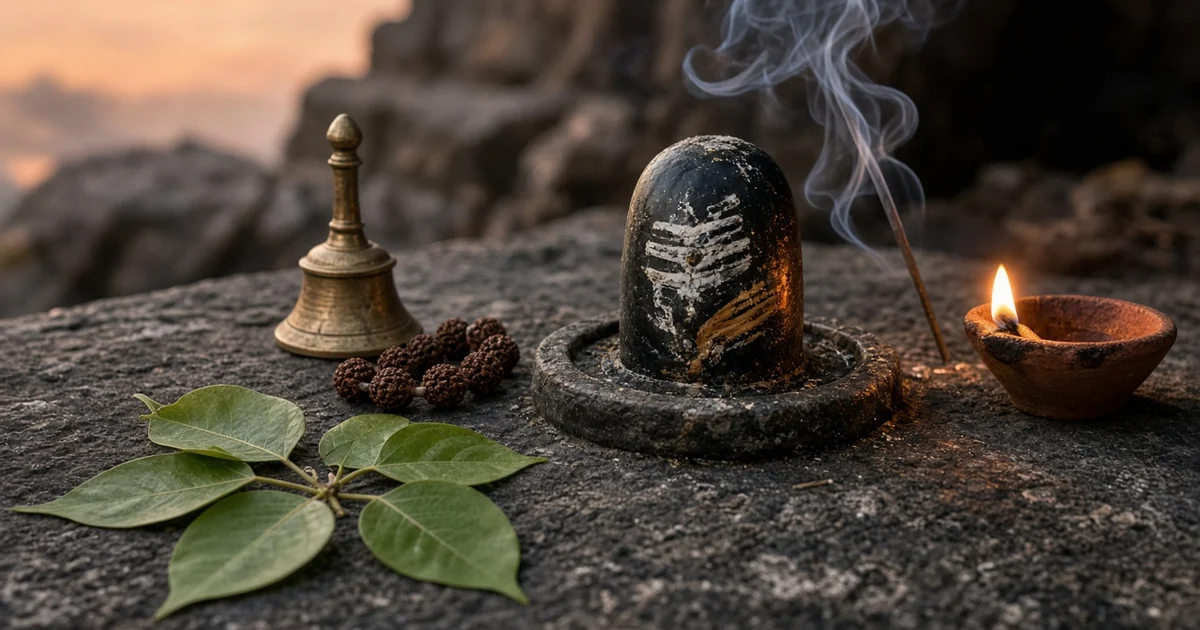
The Shiva Panchakshara Stotram is a short Sanskrit hymn on the five syllables of Namah Shivaya — na, ma, śi, va and ya. Each verse praises Shiva under one of those syllables and ends with tasmai …kārāya namaḥ śivāya, “salutation to Shiva, who is that syllable.”
The hymn is traditionally attributed to Adi Shankaracharya. The colophon of the recension followed here names him as the author; as with many stotras, that is a traditional ascription rather than a modern historical proof. In practice the hymn is recited before a Shiva lingam, often with an offering of bilva leaves, and it sits naturally beside the Lingashtakam and the daily chant of Om Namah Shivaya.
The five-syllable mantra itself is older than this stotra. A close form, namaḥ śivāya ca, is already in the Śrī Rudram of the Yajur Veda. This page is the hymn, not a substitute for that Vedic recitation.
English meanings below are original, written from the Sanskrit, and are not copied from the translation printed with the source edition.
How the hymn is traditionally recited
Sit or stand before a lingam if you have one. Many people offer water or a few bilva leaves, recite the five verses slowly, and close with the phalashruti. The hymn is short enough to learn by heart. There is no required count; one clear recitation is complete.
The five verses
Verse 1 — na
नागेन्द्रहाराय त्रिलोचनाय भस्माङ्गरागाय महेश्वराय । नित्याय शुद्धाय दिगम्बराय तस्मै नकाराय नमः शिवाय ॥ १॥
Transliteration: nāgendrahārāya trilocanāya bhasmāṅgarāgāya maheśvarāya | nityāya śuddhāya digambarāya tasmai nakārāya namaḥ śivāya || 1||
Meaning: Salutation to Shiva, who is represented by the syllable na: to the One who wears the king of serpents as a garland, the three-eyed Lord, whose body is smeared with ash, the great Lord; the eternal, the pure, who wears the directions as his garment.
Verse 2 — ma
मन्दाकिनिसलिलचन्दनचर्चिताय नन्दीश्वरप्रमथनाथमहेश्वराय । मन्दारपुष्पबहुपुष्पसुपूजिताय तस्मै मकाराय नमः शिवाय ॥ २॥
Transliteration: mandākinisalilacandanacarcitāya nandīśvarapramathanāthamaheśvarāya | mandārapuṣpabahupuṣpasupūjitāya tasmai makārāya namaḥ śivāya || 2||
Meaning: Salutation to Shiva, who is represented by the syllable ma: to the One anointed with the waters of the Mandakini and with sandal paste, lord of Nandi and lord of the host of pramathas, the great Lord; worshipped with mandara and with many other flowers.
Verse 3 — śi
शिवाय गौरीवदनाब्जवृन्दसूर्याय दक्षाध्वरनाशकाय । श्रीनीलकण्ठाय वृषध्वजाय तस्मै शिकाराय नमः शिवाय ॥ ३॥
Transliteration: śivāya gaurīvadanābjavṛndasūryāya dakṣādhvaranāśakāya | śrīnīlakaṇṭhāya vṛṣadhvajāya tasmai śikārāya namaḥ śivāya || 3||
Meaning: Salutation to Shiva, who is represented by the syllable śi: to the auspicious One, the sun that makes the lotus face of Gauri blossom, the destroyer of Daksha’s sacrifice; to Nilakantha, whose flag bears the bull.
Verse 4 — va
वसिष्ठकुम्भोद्भवगौतमार्यमुनीन्द्रदेवार्चितशेखराय । चन्द्रार्कवैश्वानरलोचनाय तस्मै वकाराय नमः शिवाय ॥ ४॥
Transliteration: vasiṣṭhakumbhodbhavagautamāryamunīndradevārcitaśekharāya | candrārkavaiśvānaralocanāya tasmai vakārāya namaḥ śivāya || 4||
Meaning: Salutation to Shiva, who is represented by the syllable va: to the One whose head has been worshipped by the noble sages Vasistha, Agastya (Kumbhodbhava) and Gautama, by other leading seers, and by Indra and the gods; whose three eyes are the moon, the sun and fire.
Verse 5 — ya
यक्षस्वरूपाय जटाधराय पिनाकहस्ताय सनातनाय । दिव्याय देवाय दिगम्बराय तस्मै यकाराय नमः शिवाय ॥ ५॥
Transliteration: yakṣasvarūpāya jaṭādharāya pinākahastāya sanātanāya | divyāya devāya digambarāya tasmai yakārāya namaḥ śivāya || 5||
Meaning: Salutation to Shiva, who is represented by the syllable ya: to the One who takes a yaksha’s form, who wears matted hair, who holds the Pinaka bow, the ancient Lord; the shining God, who wears the directions as his garment.
Phalashruti
पञ्चाक्षरमिदं पुण्यं यः पठेच्छिवसन्निधौ । शिवलोकमवाप्नोति शिवेन सह मोदते ॥
Transliteration: pañcākṣaramidaṃ puṇyaṃ yaḥ paṭhecchivasannidhau | śivalokamavāpnoti śivena saha modate ||
Meaning: This sacred five-syllable hymn — one who recites it in the presence of Shiva attains Shiva’s world and rejoices there with Shiva.
The colophon in the source edition reads: iti śrīmacchaṅkarācāryaviracitaṃ śivapañcākṣarastotraṃ samāptam — “thus ends the Shiva Panchakshara Stotra composed by Shri Shankaracharya.”
Text notes
The Sanskrit follows the recension at Sanskrit Documents, śivapañcākṣaramantrastotram, encoded and proofread by Anand Hudli (latest update 15 September 2020). English on this page is original and is not taken from the translation printed with that file.
Variants noted in that edition, and not used as the main reading here, include vilocanāya for trilocanāya in verse 1, and makāramahitāya in place of makārāya in the refrain of verse 2. In verse 4, kumbhodbhava is a well-known name of the sage Agastya. In verse 5, yakṣasvarūpa refers to a fearsome or nature-spirit form of Shiva; it is not a claim that Shiva is only a yaksha.
The closing verse uses pañcākṣaram idaṃ puṇyam — “this sacred five-syllable (hymn).” In context it points to the stotra just recited, which is built on the mantra namaḥ śivāya, not to a different text.
Related reading
The mantra itself is explained in Om Namah Shivaya: meaning and practice and on the Om Namah Shivaya mantra page. A companion hymn of eight verses to the lingam is the Lingashtakam. Other Shiva hymns on this site include the Rudrashtakam, the Shiva Tandava Stotram, the Kalabhairava Ashtakam and powerful Shiva mantras. Maha Shivratri 2027 falls on 6 March.
Frequently Asked Questions
Who composed the Shiva Panchakshara Stotram?
The hymn is traditionally attributed to Adi Shankaracharya. The colophon of the Sanskrit Documents recension used here names him as the author. As with many stotras, that ascription is traditional rather than a modern historical proof.
What is the Shiva Panchakshara Stotram?
It is a five-verse Sanskrit hymn in which each verse praises Shiva as represented by one syllable of the mantra Namah Shivaya: na, ma, śi, va and ya. A short phalashruti follows the five verses.
How is the Panchakshara Stotram different from the mantra Om Namah Shivaya?
Om Namah Shivaya is the five-syllable (or, with Om, six-syllable) mantra itself. This stotra is a hymn of praise built on those syllables, meant to be recited, often before a lingam and with bilva leaves. The two belong together in practice but are not the same text.
When should I recite the Shiva Panchakshara Stotram?
It is commonly recited during Shiva puja, on Mondays, Pradosh and Maha Shivratri, and as a short companion to Om Namah Shivaya. There is no single required hour. A slow recitation in front of a lingam is the usual setting.
How many verses are in the Shiva Panchakshara Stotram?
Five verses, one for each syllable, plus a two-line phalashruti. Some prints list a slightly different wording in verses 1 or 2; the variants are noted in the text notes.