
🤲 Practice Guides
Chin Mudra: Meaning, How to Do It, and How It Differs from Gyan Mudra
Last updated: November 22, 2026
Chin Mudra uses the same thumb-and-index join as Gyan Mudra, but on this site the palms face down. Here is the form, the meaning, and a clear distinction from the palms-up gesture.
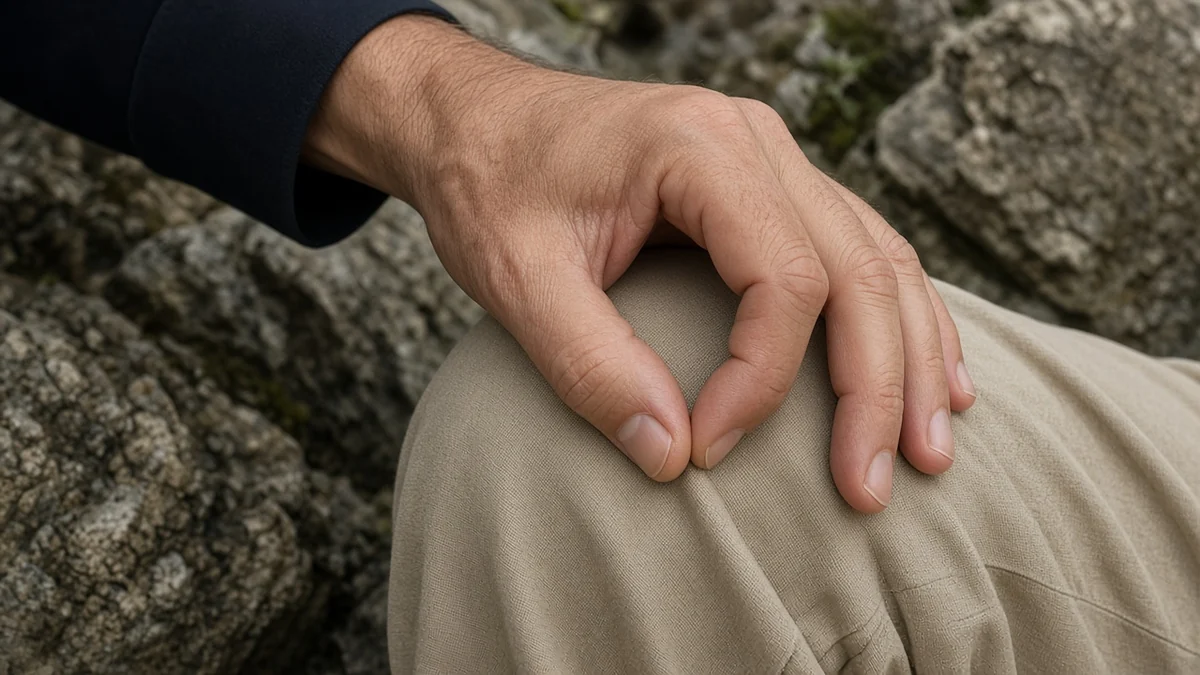
Chin Mudra (चिन्मुद्रा, also written Cin Mudra) is the “seal of consciousness”: a hand position in which the tip of the index finger touches the tip of the thumb, the other three fingers stay extended, and — in the form taught on this page — the palms face down on the knees or thighs.
The finger join is the same as in Gyan Mudra. What distinguishes the two on this site is the direction of the palms. That naming is the one already used in our guide to mudras (“Chin Mudra: same as Gyan Mudra, palms facing down”). It is not the only naming in circulation, and the difference is explained honestly below. The hero image is a close view of the palms-down form: you see the back of the hand and the knuckles, not an open palm. The Gyan Mudra hero shows the palms-up form beside a lotus pond, so the two pictures should not be confused.
Chin Mudra meaning
Chin here comes from chit, consciousness or awareness. Mudra means seal or gesture. Chin Mudra is therefore the seal of consciousness, a reminder to sit awake rather than a claim that the hands produce a special mental state on their own.
In Hindu iconography, Shiva as Dakshinamurti, the teacher, is often shown with this thumb-and-index gesture. For that teacher-form, see the Dakshinamurthy Stotram. The same join, in elemental language, is said to bring the air element of the index finger to the fire of the thumb; these associations are traditional, not a medical map of the hand.
| Sanskrit name | Chin Mudra (चिन्मुद्रा) |
| Meaning | Seal or gesture of consciousness |
| Fingers | Index fingertip touches thumb tip; middle, ring and little fingers extended |
| Palm direction on this page | Palms facing down, on the knees or thighs |
| Used with | Seated meditation, pranayama, mantra japa |
| Duration | 5 minutes to start; 15–30 minutes with practice |
How to do Chin Mudra step by step
- Sit on a chair, cushion, or mat in a position you can maintain without strain.
- Rest the backs of the hands toward the sky, so the palms face the thighs or knees.
- On each hand, bring the tip of the index finger lightly to the tip of the thumb, making a small circle.
- Let the middle, ring and little fingers extend along the knee, without stiffness or splaying.
- Soften the shoulders and breathe normally. When the mind wanders, return to the fingertip contact and to one breath.
Five quiet minutes is enough for a first practice. When finished, separate the fingers, move the wrists, and notice the body before standing.
Chin Mudra and Gyan Mudra: the naming
The finger position is the same. What changes, when teachers distinguish the two, is only the palm.
- On this site: Gyan Mudra is taught with the palms up; Chin Mudra with the palms down. That is also how the table in What are mudras is written.
- Other manuals reverse the names. B.K.S. Iyengar’s Light on Yoga and some later yoga books call the palms-up form Chin Mudra and the palms-down form Jnana (Gyan) Mudra.
- Some lineages use the names interchangeably, or treat one label as a synonym of the other.
None of these is a reason to argue. Choose the palm direction that lets the elbows, wrists and shoulders rest, or the form your teacher already uses, and stay with one name so the two pages on this site remain clear. Palms down may feel more settled; palms up, more open. Those are experiential descriptions, not physiological rules.
Traditional benefits and realistic expectations
Teachers traditionally associate Chin Mudra with a steady, conscious sitting, with calm, and with the same themes of attention that attach to Gyan Mudra. The realistic benefit is the one you can test: the hands have a clear place to rest, and wandering attention has a fingertip to return to. The gesture is not a treatment for anxiety, insomnia, or poor memory. Seek appropriate care when symptoms affect daily life.
Precautions
Do not press the fingertips, lock the elbows, or hold the arms away from the body. Stop if you feel pain, tingling, numbness or cramping, especially if you have a hand injury or a nerve condition. Support the forearms with a cushion if the shoulders tire.
Related mudras
- Gyan Mudra — the same finger join, taught on this site with the palms facing up.
- Hakini Mudra — the fingertips of both hands meet one another.
- Prana Mudra — ring and little fingers to the thumb.
- Ashwini Mudra — a seated hatha practice, not a hand gesture.
- All hand mudras and their meanings
Frequently Asked Questions
What is the difference between Chin Mudra and Gyan Mudra?
The finger position is the same: the tip of the index finger touches the tip of the thumb, and the other three fingers stay extended. On this site, and in the table on What are mudras, Chin Mudra is the palms-down form and Gyan Mudra is the palms-up form. Some modern yoga manuals, including Iyengar's Light on Yoga, reverse those names. Lineages also use the two names interchangeably. Follow one teacher's usage and stay with it.
How do you form Chin Mudra?
Sit comfortably, rest the hands on the knees or thighs with the palms facing down, touch the tip of each index finger lightly to the tip of the thumb, and let the middle, ring and little fingers extend without stiffness.
What does Chin Mudra mean?
Chin (from chit) means consciousness or awareness. Mudra means seal or gesture. So Chin Mudra is the seal of consciousness: a settled hand position used in seated meditation, traditionally associated with a steady, awake mind.
Does Chin Mudra medically improve concentration?
It is traditionally associated with awareness and calm, but it should not be presented as a proven treatment for poor concentration, anxiety, or another condition. Seek appropriate professional care when symptoms affect daily life.
Which image is which on this site?
The Gyan Mudra page shows the palms-up form beside a lotus pond at sunrise. This page shows the palms-down form: the back of the hand and the knuckles face upward, and the thumb and index meet in a circle at the knee.