
🤲 Practice Guides
Hakini Mudra: Meaning, How to Do It, Benefits, and Precautions
Last updated: November 22, 2026
Hakini Mudra is a two-hand gesture: the thumbs and the four fingers of each hand meet their partners, palms slightly apart, often held at the chest. Here is the accurate form, the meaning, and the limits of the traditional claims.
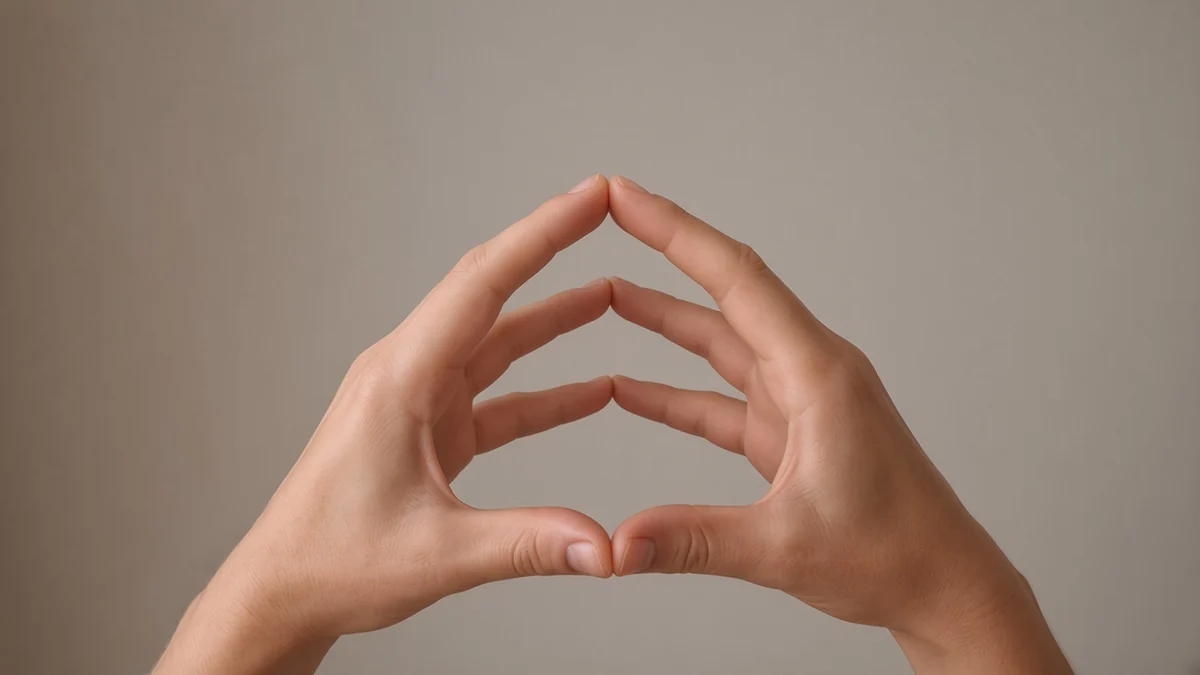
Hakini Mudra (हाकिनी मुद्रा) is a two-hand gesture in which each fingertip of one hand meets the matching fingertip of the other: thumb to thumb, index to index, middle to middle, ring to ring, and little to little. The palms face each other and stay slightly apart, so the hands form a light dome or tent of contacts, often held in front of the chest.
The name is linked to Hakini, a goddess associated in some tantric and yogic lists with the ajna, or brow, centre. That association explains why the mudra is taught as a gesture of attention; it is not a requirement that you accept a particular map of the chakras in order to sit with the hands this way. For the wider context of hand mudras, see What are mudras.
The hero image shows the characteristic fingertip dome, with the thumbs and the index, middle and ring fingertips clearly in contact and the palms apart. Complete the mudra by bringing the little fingertips together in the same way, so all five pairs touch. Do not press.
How to do Hakini Mudra step by step
- Sit comfortably, with the spine naturally upright and the shoulders soft.
- Raise both hands in front of the chest, or a little below, with the palms facing each other.
- Keep a small space between the palms. They should not press together as they do in Anjali Mudra.
- Touch the fingertips in five pairs: thumb to thumb, index to index, middle to middle, ring to ring, and little to little. Let the fingers be slightly rounded and spread, like the ribs of a small tent.
- Hold the contacts lightly. If you wish, rest the tip of the tongue at the palate; this is optional.
- Breathe normally. When the mind wanders, return to the five points of contact and to one breath.
A few minutes is enough to begin. When you finish, separate the hands, shake the fingers out, and notice the wrists and shoulders before standing.
Hakini Mudra and other gestures
- Anjali Mudra presses the palms together; Hakini keeps them apart.
- Gyan Mudra and Chin Mudra are each formed on one hand, with the index and thumb. Hakini needs both hands and all five fingers of each.
- Ashwini Mudra is not a hand gesture at all.
Traditional benefits and realistic expectations
Teachers traditionally associate Hakini Mudra with concentration, memory, and a gathered mind, which is why it is sometimes suggested during study. Those themes are traditional. They should not be turned into a claim that a hand position will treat memory loss, attention disorders, headache, or another medical condition. Seek appropriate professional care when symptoms affect daily life.
A realistic benefit is simpler: the hands have a symmetrical, slightly demanding shape, which can remind you to come back to the sitting.
Precautions
Do not clamp the fingertips or hold the elbows out rigidly. Stop if you feel pain, tingling, numbness or cramping. People with arthritis, a hand injury, or a nerve condition should keep the contacts very light or skip the mudra. The optional tongue position should be restful, not a force against the palate.
Related mudras
- Chin Mudra and Gyan Mudra — one-hand thumb-and-index gestures.
- Prana Mudra — ring and little fingers to the thumb.
- Anjali Mudra — palms together at the heart.
- All hand mudras and their meanings
Frequently Asked Questions
How do you form Hakini Mudra?
Raise both hands in front of the chest, palms facing each other but not pressed together. Touch each fingertip to the matching fingertip of the other hand: thumb to thumb, index to index, middle to middle, ring to ring, and little to little. The fingers stay slightly rounded and spread, like a light dome or tent. Hold the mudra gently; do not clamp the tips.
Is Hakini Mudra the same as Anjali or Namaste?
No. In Anjali Mudra the palms are pressed together. In Hakini Mudra the palms stay apart and only the five pairs of fingertips meet.
What is Hakini Mudra used for?
It is traditionally used as a concentration and memory gesture, sometimes with the tongue lightly at the palate, during study or a short sitting. Those associations are traditional. It is not a proven treatment for memory loss, poor focus, or another medical condition.
Does the tongue have to touch the palate?
Some teachers add that detail; others teach only the hands. If you include it, rest the tip of the tongue lightly at the palate. It is optional, and it is not visible in the photograph on this page.
How long should a beginner hold Hakini Mudra?
Begin with a few minutes during quiet breathing or study, and stop if the hands tire or tingle. There is no required duration.