
🔱 Practice Guides
Rudrashtakam: Sanskrit, Transliteration and Meaning
Last updated: November 22, 2026
The Rudrashtakam is Tulsidas's eight-verse Sanskrit hymn to Shiva, from the Uttarkand of the Ramcharitmanas. Here is the full text in Devanagari, IAST and original English, with a short note on its ārṣa usages.
The Rudrashtakam is an eight-verse Sanskrit hymn to Shiva as Rudra, composed by Goswami Tulsidas. It stands in the Uttarkand of the Ramcharitmanas, after doha 107. This page gives the eight verses and the short phalashruti in Devanagari, IAST and original English meanings. A shorter guide, without the full text, is already on the site as Rudrashtakam meaning.
The English meanings are original to VedicVani. The Sanskrit was checked against the Sanskrit Documents edition (transliterated and proofread by Girish Beeharry, Gadi Manoj and others; latest update 21 February 2025). Tulsidas died in 1623; the Ramcharitmanas is in the public domain.
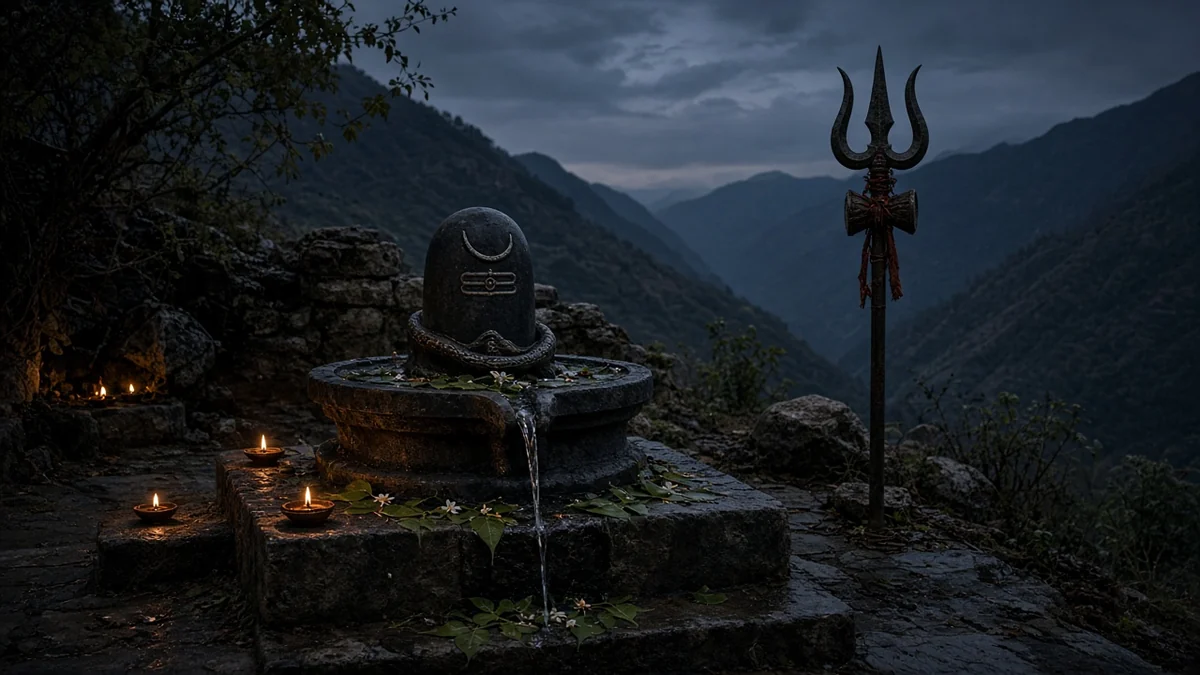
The hymn holds two qualities together, as much Shaiva poetry does: a form that is terrible — Time’s own death, a blue throat, a garland of skulls — and a refuge that is asked for simply, without claim to yoga, japa or puja. The image on this page is a mountain lingam at dusk, with a crescent, a serpent, flowing water, bilva and a trident, seen from a few metres.
How the hymn is recited
The Rudrashtakam is often recited on Mondays, on Maha Shivratri, and as a short daily stotra. A common practice is to bathe, sit before a Shiva lingam or image, offer water and a bilva leaf if you have them, and read the eight verses slowly, once or three times, ending with the phalashruti. It sits well beside Om Namah Shivaya, the Shiva Tandava Stotram, and the Kalabhairava Ashtakam.
The eight verses
\n### Verse 1
नमामीशमीशाननिर्वाणरूपं विभुं व्यापकं ब्रह्मवेदस्वरूपम् । निजं निर्गुणं निर्विकल्पं निरीहं चिदाकाशमाकाशवासं भजेऽहम्
namāmīśamīśānanirvāṇarūpaṃ vibhuṃ vyāpakaṃ brahmavedasvarūpam | nijaṃ nirguṇaṃ nirvikalpaṃ nirīhaṃ cidākāśamākāśavāsaṃ bhaje’ham
Meaning. I bow to the Lord, to Ishana, whose form is nirvana; to the all-pervading one, whose nature is Brahman and the Veda. I worship that which is his own: beyond the gunas, without alternative, without craving, the space of awareness, dwelling in space. \n### Verse 2
निराकारमोंकारमूलं तुरीयं गिराज्ञानगोतीतमीशं गिरीशम् । करालं महाकालकालं कृपालं गुणागारसंसारपारं नतोऽहम्
nirākāramoṃkāramūlaṃ turīyaṃ girājñānagotītamīśaṃ girīśam | karālaṃ mahākālakālaṃ kṛpālaṃ guṇāgārasaṃsārapāraṃ nato’ham
Meaning. Formless, the root of Om, the fourth (turiya); beyond speech, knowledge and the senses; Lord, Lord of the mountain. Terrible, the death of great Time, yet compassionate; the abode of virtues, beyond samsara — I bow. \n### Verse 3
तुषाराद्रिसंकाशगौरं गभीरं मनोभूतकोटिप्रभाश्रीशरीरम् । स्फुरन्मौलिकल्लोलिनीचारुगङ्गा लसद्भालबालेन्दु कण्ठे भुजङ्गा
tuṣārādrisaṃkāśagauraṃ gabhīraṃ manobhūtakoṭiprabhāśrīśarīram | sphuranmaulikallolinīcārugaṅgā lasadbhālabālendu kaṇṭhe bhujaṅgā
Meaning. Fair as the snow mountain, deep; his body has the beauty-splendour of a crore of mind-born gods. The lovely Ganga plays as a wave in his shining hair; a young moon is on the brow, a serpent at the throat. \n### Verse 4
चलत्कुण्डलं भ्रूसुनेत्रं विशालं प्रसन्नाननं नीलकण्ठं दयालम् । मृगाधीशचर्माम्बरं मुण्डमालं प्रियं शङ्करं सर्वनाथं भजामि
calatkuṇḍalaṃ bhrūsunetraṃ viśālaṃ prasannānanaṃ nīlakaṇṭhaṃ dayālam | mṛgādhīśacarmāmbaraṃ muṇḍamālaṃ priyaṃ śaṅkaraṃ sarvanāthaṃ bhajāmi
Meaning. Swinging earrings, a fine brow, wide eyes; a gracious face, a blue throat, compassionate. Clothed in the hide of the lord of deer, a garland of skulls: I worship the beloved Shankara, lord of all. \n### Verse 5
प्रचण्डं प्रकृष्टं प्रगल्भं परेशमखण्डमजं भानुकोटिप्रकाशम् । त्रयःशूलनिर्मूलनं शूलपाणिं भजेऽहं भवानीपतिं भावगम्यम्
pracaṇḍaṃ prakṛṣṭaṃ pragalbhaṃ pareśamakhaṇḍamajaṃ bhānukoṭiprakāśam | trayaḥśūlanirmūlanaṃ śūlapāṇiṃ bhaje’haṃ bhavānīpatiṃ bhāvagamyam
Meaning. Fierce, pre-eminent, bold, the supreme Lord; undivided, unborn, shining like a crore of suns. He who uproots the three kinds of pain, the one who holds the spear: I worship Bhavani’s lord, who is reached by feeling. \n### Verse 6
कलातीतकल्याणकल्पान्तकारी सदा सज्जनानन्ददाता पुरारी । चिदानन्दसन्दोहमोहापहारी प्रसीद प्रसीद प्रभो मन्मथारी
kalātītakalyāṇakalpāntakārī sadā sajjanānandadātā purārī | cidānandasandohamohāpahārī prasīda prasīda prabho manmathārī
Meaning. Beyond the arts, auspicious, the one who ends a kalpa; always the giver of joy to the good, the foe of the Triple City. He who steals away the mass of delusion with a flood of consciousness-bliss: be gracious, be gracious, O Lord, foe of the mind-born god. \n### Verse 7
न यावदुमानाथपादारविन्दं भजन्तीह लोके परे वा नराणाम् । न तावत्सुखं शान्ति सन्तापनाशं प्रसीद प्रभो सर्वभूताधिवासम्
na yāvadumānāthapādāravindaṃ bhajantīha loke pare vā narāṇām | na tāvatsukhaṃ śānti santāpanāśaṃ prasīda prabho sarvabhūtādhivāsam
Meaning. So long as people here, in this world or the next, do not worship the lotus feet of Uma’s lord, they do not have happiness, peace, or the ending of burning grief. Be gracious, O Lord, who dwell in all beings. \n### Verse 8
न जानामि योगं जपं नैव पूजां नतोऽहं सदा सर्वदा शम्भु तुभ्यम् । जराजन्मदुःखौघतातप्यमानं प्रभो पाहि आपन्नमामीशशम्भो
na jānāmi yogaṃ japaṃ naiva pūjāṃ nato’haṃ sadā sarvadā śambhu tubhyam | jarājanmaduḥkhaughatātapyamānaṃ prabho pāhi āpannamāmīśaśambho
Meaning. I do not know yoga, nor japa, nor puja. I bow to you always, at all times, O Shambhu. Burning in the flood of the pains of age and birth, O Lord, protect me in this distress — I bow, O Lord Shambhu. \n### Phalashruti
रुद्राष्टकमिदं प्रोक्तं विप्रेण हरतोषये । ये पठन्ति नरा भक्त्या तेषां शम्भुः प्रसीदति ।
rudrāṣṭakamidaṃ proktaṃ vipreṇa haratoṣaye | ye paṭhanti narā bhaktyā teṣāṃ śambhuḥ prasīdati ||
Meaning. This Rudrashtakam was spoken by the brahmin for the pleasing of Hara. Shambhu is gracious to those people who recite it with devotion.
Text notes
- The hymn is Tulsidas’s, from the Ramcharitmanas, Uttarkand, after doha 107. The language is Sanskrit with some Hindi-influenced or ārṣa usages, which the Sanskrit Documents notes treat as valid in the tradition of the sages even where they are not strictly Paninian.
- Examples kept as transmitted: śambhu in the vocative in verse 8 beside the regular śambho; bālendu without a visarga in verse 3; bhujaṅgā treated as feminine, in part to stand with gaṅgā; haratoṣaye in the phalashruti rather than haratoṣāya; purārī and manmathārī in verse 6.
- Verse 3 is a descriptive stanza and does not end with an explicit “I bow,” unlike most of the others.
- The English meanings are original. They do not reproduce the Hindi bhāvārth or any published English translation printed with the hymn.
Related reading
A shorter introduction is at Rudrashtakam meaning. For other Shiva hymns on this site, see the Shiva Tandava Stotram, the Lingashtakam, the Shiva Panchakshara Stotram, the Kalabhairava Ashtakam, Om Namah Shivaya and powerful Shiva mantras. For the night on which many families recite this hymn, see Maha Shivratri 2027 and the Maha Shivratri story. A wider starting point is the beginner’s guide to Hindu mantras.
Frequently Asked Questions
Who composed the Rudrashtakam?
The hymn is by Goswami Tulsidas. It stands in the Uttarkand of the Ramcharitmanas, after doha 107. Tulsidas died in 1623, so the text is in the public domain.
How many verses does the Rudrashtakam have?
Eight verses, as the name ashtakam says, plus a short phalashruti. This page gives all eight and the closing verse.
When is the Rudrashtakam recited?
Many families recite it on Mondays, on Maha Shivratri, and as a short daily Shiva hymn. Its length makes it easier to learn than a longer stotra.
Is the Sanskrit of the Rudrashtakam strictly classical?
Not always. Tulsidas's Sanskrit here shows some Hindi-influenced or ārṣa forms — for example शम्भु in the vocative beside शम्भो, बालेन्दु without a visarga, and हरतोषये in the phalashruti. They are kept as transmitted and noted below.
Where can I read a shorter guide?
A shorter introduction, without the full text, is on our [Rudrashtakam meaning](/blog/rudrashtakam-meaning/) page. The two pages are meant to be read together.