
📚 Mythology
Indian Mythological Stories: 12 Stories and Their Lessons
Last updated: August 31, 2026
Indian mythology is a vast living tradition of stories about courage, duty, devotion, pride, compassion, and the consequences of choice. Begin with these twelve narratives.
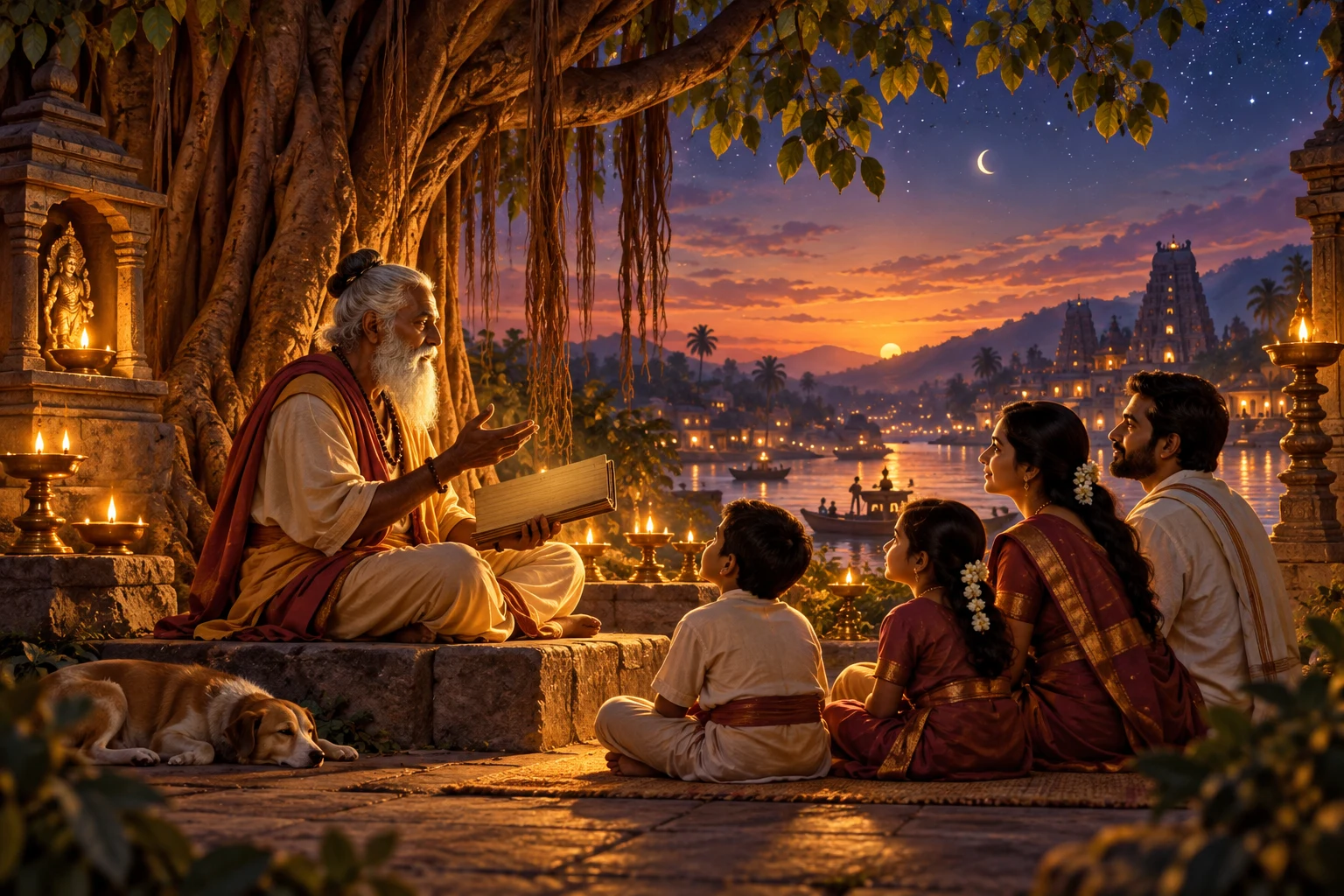
Indian mythological stories include the stories of Rama, Krishna, Shiva, Durga, Ganesha, Hanuman, and many other figures found in the Ramayana, Mahabharata, Puranas, and regional traditions. They are not one closed book or one uniform sequence: the same figure may be described differently in different texts and communities, and that variety is part of what makes the tradition living rather than merely historical.
The twelve stories below are a beginner-friendly map. They are not presented as scientific history, and they should not be flattened into simple “good versus bad” morals. Each narrative raises questions about dharma, power, devotion, promise, grief, humility, and the responsibility that comes with knowledge. For stories organised by deity instead of by theme, see Indian mythological stories in English and the Hindu deities guide.
Where the stories come from
The oldest layer is the Vedas and Upanishads, mostly hymns and philosophy rather than narrative. The great story collections come later: the two epics — the Ramayana and the Mahabharata — and the eighteen major Puranas, which gather the myths of Vishnu, Shiva, Devi, and the others. On top of these sit countless regional retellings in Tamil, Telugu, Bengali, Awadhi, and other languages, plus temple legends (sthala puranas) and living oral tradition. When two versions of a story disagree, both are usually authentic to their own communities.
Indian mythological stories at a glance
New readers can start with Rama’s return for the Ramayana, Krishna and Arjuna for the Bhagavad Gita, Prahlada for Vishnu devotion, or Durga and Mahishasura for Navratri. Each story below links to a longer guide so you can continue to its text, festival, or devotional context.
1. Rama’s exile and return
The Ramayana follows Rama’s exile, Sita’s abduction, Hanuman’s service, the war with Ravana, and the return to Ayodhya. Its central questions include whether duty can be separated from personal happiness, how a single promise reshapes a family, and what makes leadership worthy of trust. Read the full arc in Ramayana stories, meet the cast in characters of the Ramayana, and read the story of Hanuman and Rama alongside the Diwali story.
2. Hanuman’s leap to Lanka
When the search for Sita reaches the ocean, Hanuman discovers that his strength has been forgotten. With encouragement, he remembers his ability and crosses the sea. The episode is not only about supernatural power; it is about confidence awakened by wise guidance. Hanuman uses courage with intelligence, restraint, and service. See Stories of Hanuman for more.
3. Prahlada and Narasimha
Prahlada remains devoted to Vishnu despite the violence and pride of his father, Hiranyakashipu. Vishnu appears as Narasimha, neither fully human nor animal, at a time and place that bypass the protections of a boon. The story explores the danger of arrogance and the idea that divine protection cannot be reduced to ordinary categories. See the Narasimha Jayanti story and the ten avatars of Vishnu.
4. Krishna’s childhood in Vrindavan
Stories of Krishna’s childhood include his playful theft of butter, friendship with cowherds, protection of the community, and the lifting of Govardhan Hill. Different traditions read these episodes through devotion, divine play, community responsibility, and the transformation of fear. They are especially important during Janmashtami and Govardhan Puja. Read Stories of Lord Krishna and, for his later life in Dwarka, the wives of Lord Krishna.
5. Krishna and Arjuna on the battlefield
The Bhagavad Gita begins when Arjuna is overwhelmed by the prospect of fighting people he loves and respects. Krishna does not give him a shallow command to “be positive.” He develops a long teaching about the self, duty, action, meditation, devotion, and discernment. Begin with the Gita shlokas with meaning, then read the complete Bhagavad Gita and the 18 days of the Mahabharata war that follow it.
6. Savitri and Satyavan
Savitri’s story is associated with loyalty, intelligence, courage, and the power of dialogue. When Yama comes for Satyavan, Savitri follows and speaks with such clarity that she receives blessings which ultimately make the return of her husband possible. The narrative is often connected with the Vat Savitri observance, though interpretations of gender, marriage, and agency differ. Read the Vat Savitri guide.
7. Samudra Manthan, the churning of the ocean
Devas and asuras cooperate to churn the cosmic ocean in search of amrita. The process releases both treasures and danger, including poison that Shiva contains for the protection of creation. The story shows that great aims can bring unexpected consequences, and that cooperation, strategy, sacrifice, and responsibility all matter. It also introduces many figures central to later Hindu stories.
8. Ganesha and the fruit of wisdom
In a popular story, Ganesha and Kartikeya are asked to circle the world. Kartikeya travels widely, while Ganesha circles his parents and explains that they are his world. The tale is a compact meditation on wisdom, perception, family honour, and the difference between speed and understanding. It is often told at moments of new beginnings.
9. The descent of the Ganga
Bhagiratha’s penance brings the Ganga from the heavens, but Shiva receives the force of her descent through his matted hair so that the earth is not destroyed. The story connects devotion with persistence and shows why powerful blessings also require a responsible channel. It helps explain the sacred significance attached to the Ganga and the festival of Ganga Dussehra.
10. Shiva and the poison of the ocean
During the churning of the ocean, the halahala poison threatens all beings. Shiva takes it into his throat, and Parvati prevents it from spreading through his body. This image of Neelkantha is a story of protection and containment: not every danger can be denied, but it must be handled without allowing it to poison the whole world. It is one reason Shiva stories remain powerful during Maha Shivratri.
11. Durga and Mahishasura
The goddess Durga battles Mahishasura, a force that changes form and cannot be defeated by ordinary assumptions. Her victory is celebrated during Navratri and Dussehra. The narrative honours courage, collective divine power, and the destruction of oppression. The nine forms of Durga guide shows how the festival develops this theme across nine nights.
12. Vamana and King Bali
King Bali is generous, powerful, and devoted, but his growing authority becomes a cosmic concern. Vishnu appears as Vamana and asks for three steps of land. Bali keeps his promise even when the request reveals its vastness, and the story becomes a meditation on generosity, pride, surrender, and the relationship between power and humility. Regional traditions connect Bali with different festivals, including Onam.
How to read mythology respectfully
Read a story in more than one version when possible. Ask who is telling it, which text or region it comes from, and what the audience is meant to notice. Avoid using one retelling to dismiss an entire tradition. Mythological stories can carry theology, ethics, poetry, ritual memory, social questions, and local identity at the same time.
The most useful question is not only “Did this really happen?” but also “What is this story asking people to remember, practise, fear, or change?” That approach keeps the stories connected to the temples, festivals, prayers, and communities in which they continue to live.
Frequently asked questions
What is Indian mythology?
The body of sacred and legendary stories drawn from the Vedas, Puranas, the Ramayana, the Mahabharata, and regional and oral traditions of the Indian subcontinent. It is not a single fixed text but a living tradition with many authentic versions of the same story.
What is the difference between the Ramayana and the Mahabharata?
The Ramayana follows Rama’s exile, Sita’s abduction, and the war with Ravana. The Mahabharata follows the Kurukshetra war between the Pandavas and Kauravas and contains the Bhagavad Gita as one of its episodes. The Mahabharata is far longer and covers a wider cast of characters.
Which Indian mythological story should a beginner read first?
The Hanuman and Rama story, a Krishna childhood story, or the Durga and Mahishasura story are accessible starting points. Choose one, then explore its related festival or mantra.
Are Indian mythology stories and Hindu mythology stories the same thing?
The phrases are often used interchangeably in English. This guide focuses on Hindu mythological stories from major Sanskrit texts and living regional traditions, while recognising that India also has many other religious, folk, and local storytelling traditions.
Are Hindu mythological stories meant to be taken literally?
Traditions vary. Many readers hold theology, symbolism, and history together rather than treating the stories as literal science or dismissing them as fiction. Reading more than one version helps.
Where can I read these stories organised by deity?
See Indian mythological stories in English, which groups the stories around Krishna, Shiva, Durga, Hanuman, Rama, and Ganesha.